
GMAT Verbal
GMAT Verbal Time Management: Speeding up on CR & RC
In this post I want to address one aspect of dealing with time management on the Verbal section of the GMAT: shaving time off of Critical Reasoning and Reading Comprehension questions. I recently tutored a couple of students who really benefitted from this advice so hopefully it can help other readers out there!
First, it’s probably good to first understand that there are 2 general ways to save time on either section of the test: global time management strategies and question-specific time management strategies. Global time management strategies deal with how to manage yourself across the entire section – in other words, choosing to selectively dump questions, allocating a little more time to the early questions, etc. I plan to write a post about these “big picture” time management strategies for the Verbal section so stay tuned for that (and I have already written a couple for the Quant section so feel free to check those out here and here). But in this post I am getting more at ways to shave time off individual questions, in this case Critical Reasoning and Reading Comprehension.
Here is the most important thing to understand: it’s hard to do well on RC or CR if you don’t really, really understand the passages (the “passages” in CR are really referred to as “stimuli” so I will use that nomenclature from here on out). What I have noticed with the people I have tutored (and what I intuitively know to be true for myself as well) is that it’s just really hard to read more quickly than you are capable of reading without experiencing a significant drop in comprehension. Now, just to be clear, there are definitely ways to read more effectively, on Reading Comprehension passages in particular. But that is really about becoming better at that skill and becoming faster just becomes a natural outgrowth of understanding HOW to read the passages more effectively.
However, if you genuinely need 3 minutes to read a Reading Comp passage or 1 minute to really process a Critical Reasoning stimulus, then forcing yourself to do it faster is likely going to cause you to so poorly understand what you just read that you will not only spend more time going through the answer choices, but also get more questions wrong. I know this to be true for myself as well. I scored a 780 on the GMAT and I am NOT a fast reader. If you forced me to read something more quickly that I am capable of processing it, I wouldn’t understand much of what I read. Believe me, I have tried!
Well then, how do you shave time off Critical Reasoning and Reading Comp then? It’s really all at the answer choices. Here’s the thing. If you really properly read a reading comp passage or critical reasoning stimulus, you should have a pretty good shot of answering the questions quickly, probably on an initial read through the answer choices. This may not be true for a detail question on Reading Comp since often on those questions you really do need to go back to the passage and reread what was written about the detail in question, but on most of the other questions you may be able to be pretty fast and only sacrifice a little bit in terms of accuracy.
The above is true in particular for Critical Reasoning. Let’s take a question from the Big 4 (this is the nomenclature I use for strengthen, weaken, assumption, and useful to evaluate questions, all of which are very, very similar). If you understand precisely (and I mean precisely) what the conclusion is, understand what that conclusion is based on, and have an idea of what a potential gap is between the evidence and the conclusion, you will very likely sense the right answer when you read it. As important or more important, you will probably sense what is wrong (especially what is outside the scope or irrelevant) right away. So you may be able to read pretty quickly through the answers and have a very good sense of what the right answer is.
Now, if you had the time you might want to read back through some of the answers again, then go back to the stimulus and reread it, etc. And this may ultimately yield a different answer. But if you really read the stimulus in the right way from the outset, you can often end up with the right answer even just on your initial read through the answers.
There is a very easy way to experiment with and practice this: start a timer, read the stimulus really carefully and effectively (I often read the stimulus 2 or even 3 times before I really understand it at the level that I need to), and then read through the answer choices and select your answer (trying to be pretty fast at the answer choices). Stop the clock and see how much time you spent. Then WITHOUT LOOKING AT THE CORRECT ANSWER, restart the clock and spend as much additional time as you want, rereading the answer choices, going back to the stimulus, etc. Then compare your answers and the time spent. I have done this experiment with many of the people I tutor and the result is usually that with significantly less time people tend to get roughly the same number of questions correct. Sometimes they change their answer from wrong to right, but other times they change it from right to wrong, and it usually more or less evens out. And most of the time people end up picking the same answer in the end anyway, again often with significantly less time.
A similar thing can be done with Reading Comp. I personally find that if I understand a reading comp passage really well (again there is a skill to reading the passages effectively that falls outside the scope of this post) I can answer most of the questions pretty quickly. On the actual test, to the extent that I have the time to do so, I would probably go pack to the passage to verify my answers in many cases, in part because when I am taking the GMAT I am aiming for a perfect score and don’t want to get a single question wrong. But if you asked me to just pick an answer and be pretty fast with it, I would pick the right answer almost every time without needing to spend a lot time. Even on detail questions when I would be most inclined to go back and find the relevant details, I can often sense the right answer because I remember the specifics just well enough and because I can sense in the wrong answers things that just don’t fit, have the wrong tone, etc.
And to repeat, this all comes because of a very good initial read of the passage – I just would not skimp there. So on a passage that has, say, 3 paragraphs, I might spend 2 or 3 minutes reading the passage. But if I needed to I could probably answer each of the questions in about 30 seconds. If there were 4 questions and if we include the time spent reading the passage, the total time spent would average out to about 1 minute per question (2-3 minutes for the passage and 2 minutes for the questions at 30 seconds per question). Now at only 30 seconds per question I might not get every question right, but that is pretty darn fast and represents a significant time savings without a huge loss in accuracy. So if you are running out of time on Verbal and need to shave some time off, this is one way to do it.
Part of the reason I was motivated to write this post is that I recently had an experience with a guy I tutored that really served to confirm these ideas for me. This particular student initially had issues with how he was approaching Verbal questions, but as we approached his test date, it was really all about time management. Given enough time, he would get Verbal questions right at an 80-90% clip, but on his first practice test after working with me, he did not do well on Verbal. Most tellingly, he described very vividly what others I have tutored have experienced: when he was doing RC and CR questions, he was so pressed for time and was therefore reading the passages and stimuli so quickly that he basically wasn’t comprehending anything, and everything we had worked on just went out the window. So I discussed the above strategies with him, had him practice them, and on the next practice test his Verbal score went from a 34 to a 44!!! That is a ridiculous jump and 44 is an absurdly high Verbal score.
Let me conclude by mentioning that what I am discussing in this post really fits with my larger, more general theory that time spent up front on things (both on the GMAT and in life in general, actually!!!) is time well spent in the long run. So on Problem Solving questions, I really try to get the people I tutor to stop knee-jerking into a path and spend more time thinking about the question and how best to approach it (or even whether to approach it at all or just dump it). On Data Sufficiency as well, I often find that the key for many people is what they take away from the question stem – people who rush through the question stem often either take more time in the end or get the question wrong.
It is a little counter-intuitive when you are in a rush to slow things down, especially when you are eager to get started answering or solving a question and you know that time is ticking. But the extra time spent up front understanding and strategizing often pays dividends in the long run, both in terms of getting a question right and in terms of the overall time you end up spending on the question.
Verbal as the Key to a High Overall GMAT Score
In my last post I described how Data Sufficiency is, for many, the key to a high Quant score on the GMAT. I decided to continue this theme to discuss a related but, I think, more important point and one that I love to explain to people because it seems that so few people understand this fact: the key to a really high GMAT score is a high Verbal score.
On a general level, most people just tend to neglect the Verbal section of the exam. This is understandable: on the Quant section there is probably more to “learn” for most people, and this requires more time. But another factor is that for most people it is just more enjoyable to practice Quant. Verbal is like the redheaded stepchild of the family. Kicked to the curb, neglected, under-appreciated…you get the point. Oh, and Reading Comprehension? Forget about it. People NEVER practice reading comprehension. I mean, who wants to voluntarily read about a group of Pakistani poets or a new finding about globular star clusters (I hope I am not offending any fans of Pakistani poetry or would-be astronomers out there…I am actually a closet astronomy nerd so I genuinely LIKE those passages!).
GMATers just tend to ignore or neglect the Verbal part of the exam, to their own detriment. But people! The Verbal section makes up half of your score!!! More importantly, most people don’t realize that at the top end of the scoring spectrum, the Verbal score actually weighs in more heavily that the Quantitative score!!! Over the years I have tutored lots and lots of people who have Quant scores of 46-48 and Verbal scores of 35 or so and who want to focus almost exclusively on bringing their Quant score up. Nooooo!!!!!!!
Here’s the deal. Most people will not get above 48 or 49 Quant. Those are great Quant scores (you can’t just look at the percentiles, which are a little bit skewed by international applicants, many of whom do have Quant scores of 50 or in some cases 51). So for most people, it’s good to almost think of 49 as the ceiling for Quant. For reasons I won’t expound upon here, there is not that much of a difference between a 47 and 48 Quant or between a 48 and 49 Quant (in terms of how difficult it is to achieve those scores), but there IS a pretty big barrier between 49 and 50 and an even bigger barrier between 50 and 51, a barrier that most people will not cross. So if you are already at 47 Quant, you are probably near the maximum of where your Quant score will ultimately go. And bringing the Quant score from a 47 to a 49 will not have that big an impact on your overall score.
If you are at a score of, say, 47 Quant and 35 Verbal, there is much, much more room for growth on the Verbal side. And bringing your Verbal score to 40+ or, if possible, to something like 43 or 44 Verbal will do absolute wonders for your overall score. I recently tutored a girl who on her first actual GMAT got a 700 with a 45 Quant and a 41 Verbal. Now, first of all, that is a great score. She wanted higher, however, and was a little disappointed in the Quant score in particular. On her second try she got a 46 Quant and 46 Verbal for a 740!!! Now, this girl is probably capable of a Quant score of 48 or 49, but even if she had gotten a 48 Quant and combined that with her original 41 Verbal, her score would only have been about 720. I mean “only” probably isn’t the right word here, but relative to the 740 that she actually got, obviously 720 is not as impressive.
Part of the issue here is that the percentiles on Quant and Verbal can be misleading. A 49 Quant is 77th percentile whereas a 40 Verbal is 91st percentile!!! So it is really tempting to look at the Quant percentile and feel like you just aren’t doing that well. But at 49 Quant most people are probably at their ceiling! And getting a 50 Quant, while impressive, is not going to do much, if anything, to the overall score. Conversely, it is tempting to look at a Verbal score of 35 (76th percentile) and believe that you have done really, really well on Verbal. Don’t get me wrong, 35 Verbal is a good score, but that percentile is misleading for 2 related reasons. One, it is skewed by the fact that so many non-native English speakers take the GMAT. Two, it hides the fact that there is a ton of room to bring that score higher and have a huge (and I mean huge) impact on your overall score!
Again, at 40 Verbal (which really is an excellent Verbal score) it would be tempting to think that you have kind of topped out since you would be sitting at 91st percentile. Think about it from the perspective of the aforementioned girl with the 45 Quant, 41 Verbal, 700 overall. Her percentiles were 59th percentile Quant and 94th percentile Verbal!!! I almost can’t believe it now that I am writing it – those percentiles are pretty shocking. It would have been very tempting for her to completely ignore Verbal and just focus on Quant. But man, 46 Quant and 46 Verbal for a 740 is amazing and it never would have happened if she had just focused on Quant.
Now some of you out there may be thinking, yeah, but at 46 my Quant score just would not be high enough – schools want to see a higher Quant score than that. I have two things to say to that. First of all 740 is 740. That’s just a ridiculous score. Even if they want to see something more like 47 or 48+, it’s very hard for me to imagine they are going to turn away someone with a 740 on the GMAT, assuming they like everything else about the applicant. Second, and here’s the more important point: if you want a really high GMAT score (like 740 or 750), you almost certainly MUST HAVE a really high Verbal score.
For example, a 50 Quant and 38 Verbal would yield about 720. And a 49 Quant and 41 Verbal would yield about 730. And the fact of the matter is that of all the people I have tutored over the years (many hundreds so far), many more have had Verbal scores of 44 or higher than scores of 50 or 51 Quant. And of the people I have tutored who have had scores of 740 plus, more often they have had scores like 47Q/44V or 46Q/46V or even 48Q/44V than scores like 50Q/40V or 51Q/39V (both of which would “only” yield about 740, by the way!).
More and more lately I have had people come to me with the goal of 750 on the GMAT. I used to chuckle a little at that, not because I thought people were not capable of it but because that just seemed like an unnecessarily high score to strive for. Nevertheless, recently I have had many people come to me with that expressed goal. They often think that they need more help with Quant than Verbal (again usually these people have something like 47 Quant and 36 Verbal – something in that range – and are duped by the percentiles). And usually I explain to them that we can and should focus on Quant to try to get them to 48 or 49, but that we NEED to focus more on Verbal if they want to have any shot of getting close to 750.
So as you plan you overall GMAT study strategy and think about how you are going to allocate your study time, remember that at the higher reaches of the scoring scale the Verbal score becomes increasingly important. And more generally, be mindful of how misleading those percentiles can be – its better to focus on the actual scores for the Quantitative and Verbal sections. Scores like 47 Quant and 38 Verbal are both excellent scores. But if that is the range you are in or even close to, understand that there is MUCH more room for growth on the Verbal side and that bringing the Verbal score up is going to be necessary to see a big increase in your overall GMAT score.
GMAT Sentence Correction: Right Answers Are Often Deliberately Bad
People studying for the GMAT are often completely thrown by a correct answer on a sentence correction question that just “doesn’t sound good.” In their minds they think, “there is no way that can be the correct answer – that just sounds bad.” Even if that thinking is true that does not mean that the correct answer won’t sound just downright bad! Making right answers sound bad is a deliberate tactic on the part of the GMAT writers and in this piece I will explain why the do it, how I know they do it, and what you can do about it!
I often ask people, “What do you think is a defining characteristic of hard questions?” Most people often respond with some of the things that tend to happen on harder questions but the simple answer is that from the point of view of the GMAT writers the single defining characteristic common to all hard questions (Quant and Verbal) is that hard questions are ones that most people get wrong! If most people get a particular question right (even if the writers predicted that most would get it wrong), it is, by definition, not a hard question. However, because of the scoring algorithm and the way the GMAT is scored, there need to be very hard questions (in other words, questions that most people would get wrong). But how do the GMAT writers write a sentence correction question that most people will get wrong? Well, they obviously have a variety of tactics, but one of the most common and fundamental is that to make a question hard the correct answer can’t be obviously correct – if it were then most people would recognize it as correct and pick it. So the writers often deliberately write the correct answer on a sentence correction question to make it unfamiliar, awkward, even unpalatable.
Recently, while tutoring someone, I came across a sentence that really proved for me that this is a deliberate act on the part of the test writers. I pretty much knew it already, but I thought it was really interesting to see this deliberate tinkering in action. The sentence in question comes from the GMAT Prep exams. I had seen the sentence many times before, but this time I noticed that the correct answer was a little different from the one I had seen before – it was worse! So I looked into it and discovered that the sentence was in fact different in previous versions of the GMAT Prep software. After digging a little deeper I found what appears to be the original version of the sentence (from the New York Times). Low and behold we have pretty clear evidence of how the GMAT writers take a sentence, tweak it to make it less familiar and appealing, and then, when that isn’t enough, tweak it even further to make it borderline terrible (albeit correct), thereby increasing the level of difficulty even further.
So let’s start with what I believe to be the original sentence (again, from the New York Times):
“Also, unlike many other frogs that metamorphose from tadpoles to adults in one year, the high-elevation frogs take three to four years to reach adulthood, so they are restricted to deeper bodies of water that do not dry up in summer or freeze solid in winter.”
Ok, so standard comparison sentence and one that sounds pretty good in my opinion. Now let’s see how the GMAT writers changed the correct version of this sentence to make it less appealing and therefore harder:
Unlike frogs that metamorphose from tadpoles into adults within a one-year period, mountain yellow-legged frogs of the Sierra Nevada take three to four years to reach adulthood, and so they are restricted to deeper bodies of water that do not dry up in summer or freeze solid in winter.
Now, that sentence may not look that different to you, and it isn’t that different. But there are some subtle changes that make it more likely to be passed over by a test taker. The “mountain yellow-legged frogs” bit is just there because without it we don’t have the context to know what the sentence is talking about. But the less obvious and more important change is from the “so they are restricted” to the “and so they are restricted” version. Having done this question with many people I know that some people do not pick the correct answer because they believe that you can’t have two conjunctions (the “and” and the “so”) right next to each other. Indeed that usage is not that common and is therefore unfamiliar to many people, but it is acceptable and is not wrong. And since it is not wrong, it must be right!
To me that usage is not that unappealing, but what caught my eye with this sentence recently is how it was changed again to make it obviously less appealing and therefore more difficult. The most recent version on the GMAT Prep software changes the underlined part (in the correct answer) to:
“mountain yellow-legged frogs of the Sierra Nevada take three to four years to reach adulthood, with the result that they are”
Wow. I mean, maybe you readers don’t get as excited about this as I do, but my reaction is wow!!! That “with the result that they are” is pretty bad. That type of construction would typically be part of the wrong answer on most GMAT sentence correction questions. It is just not good! Here’s the thing. As unappealing as that construction is, it is not wrong! So I might initially disfavor that answer choice when I see it but I would not outright eliminate it. And on this particular question it is the right answer because the other answer choices just have other things that are definitely wrong with them.
Anyway, this is about as clear an indication as I have ever seen of how the GMAT writers try to ramp up the level of difficulty on Sentence Correction by purposely tweaking correct answers to make them unfamiliar, awkward, or even downright unappealing. So what can you do with this newfound knowledge?
The first thing is that you cannot eliminate answers because you think they sound “bad.” Wrong answers are wrong because there is something concrete wrong with them (either grammatically or on more of a logic/meaning level). So you might want to “disfavor” an answer that sounds awkward or unfamiliar, but I would not outright eliminate it. Answers are not usually wrong just because they are awkward. If an answer is absolutely hopelessly awkward to the point that it is flat out incorrect English grammar than that may be enough but usually there will be other things wrong beyond that.
It may also help you to EXPECT that the correct answer may sound a little bit off. That will be especially true on harder questions. Again there is a difference between unfamiliar or a little awkward on the one hand and hopelessly awkward or completely unidiomatic on the other. As you practice GMAT Sentence Correction questions try to learn where that dividing line sits. And again, worse case scenario, just leave the answer in play and come back to it at the end. If 2 answers are exactly the same and one is much wordier and awkward then it will be wrong. But if one answer is a little awkward but more logical and the other answer sounds better but has a concrete grammatical error that you can identify or even a logic/meaning issue, the more awkward answer will be correct.
GMAT Scoring Algorithm: Quant vs. Verbal
In this post I would like to expound upon a theory of mine that gets at the slight differences in the scoring algorithm on the Quant and Verbal sections of the GMAT. In a previous post I commented on the fact that although on the Quant section the number of questions you get right has very little to do with the score you receive, on the Verbal section the number of questions right matters much more. I don’t think there is any official explanation for this phenomenon, but I have long had a theory that I think makes pretty good logical sense. Understanding the nuances of the algorithm can help you learn what exactly you need to do to achieve a high score on each section.
Quantitative questions, by nature, are completely unambiguous. If x equals 10, then x can’t also equal 15 (well ok it can in a quadratic equation and in some other special situations, but you get the point). Verbal questions, on the other hand, are by nature a little less black and white than Math questions. Of course GMAC writes questions that are technically unambiguous, but the problem is that it is tough to make a Verbal question really, really hard without crossing the line a little into ambiguity, so there tends to be a limit to how hard a Verbal question can realistically get. That problem does not exist on Quant. There is almost no limit to how hard the test writers can make a Math question and it will still be completely unambiguous, completely black and white.
This helps explain the differences in the algorithm on each section. On Quant, the questions can pretty much just keep getting harder and harder until nearly everyone would get the questions wrong. Really only at the very top reaches of the Quant section (say scores of 49-51) will people get less than 10 questions wrong. So for most people the differentiating factor in scores on the Quant section is just the level of difficulty of the questions that test takers are able to get right consistently. If your breaking point is 650, your score is 650 (or whatever that would correspond to on the 6-51 scale that the section is scored on). If your breaking point is 720, then your score is 720. The number of questions that you get wrong is not really a factor except, perhaps, in differentiating between people who get a 49 and 50 and 51.
But since there is more of a limit to how hard a Verbal question can get (again before it starts to drift over the line into “ambiguous/unfair question territory”), the number of questions right and wrong starts to become more of a differentiating factor. That’s because many test takers get up into the very hardest Verbal questions so at that point the main way for the algorithm to differentiate between a 38 Verbal and 40 Verbal or 42 Verbal and 45 Verbal is just by number of questions wrong. This is a bit of an oversimplification since the level of difficulty of the questions may vary a little so that would still be a factor in the score, but at the higher reaches of the Verbal scoring spectrum the score really becomes much more about number of questions wrong. And to be at a really high Verbal score (like 40+) you really can’t have many questions wrong. For a 40 you might have 8 or 10 wrong, but for a 44 or 45 you are probably talking about 5 or 6 wrong or even less and then for 47 Verbal or 49 Verbal you are looking at 1 or 2 wrong total!
There are a few implications to be drawn from this. First of all, since you are likely to get a lot of questions wrong on the Quant section, it really does not make sense to spend undue time on questions that you are likely to get wrong anyway. Furthermore, running out of time at the end of the Quant section is not that big a deal (assuming that you actually select answers to all of the questions to not incur the unanswered questions penalty). Again, you are going to get a lot of questions wrong anyway so coming to question 34 with 2 minutes left and having to make some educated guesses on the last 3 or 4 questions will not impact your score that significantly.
On the Verbal section, on the other hand, you need to be much more careful about time management and not put yourself in a position of having to guess on the last 3 or 4 questions. That will impact your score more detrimentally, especially if you were tracking toward a really high score. If you had only 5 questions wrong up until question 35 and then had to guess on 36 through 41 and got 5 of those last 6 wrong for a total of 10 wrong on the Verbal section, that would be a big deal and would lower your score significantly.
Another upshot is that you need to be a little more certain of your answers on Verbal questions than on Quant questions. Most people probably feel like the opposite is what often happens since the nature of Verbal questions is that they feel ambiguous, but of course they are not and you need to be that much more rigorous in the way you choose your answers to ensure that you limit the educated guessing to a bare minimum. You just can’t afford to get Verbal questions wrong with the same frequency that you can Quant questions. What that means, practically speaking, is that you can’t run out of time on the Verbal section and that you need to choose answers because you KNOW they are right, not because you THINK they are right. That is obviously easier said then done, but see my post on The Principle of No Ambiguity for some more insight on that idea.
Knowledge is power and on the GMAT having a better understanding of the scoring algorithm is the kind of knowledge that helps lead to a better score. In a future post I am going to come back to the issue of pacing strategies on the Quant section so stay tuned!
Why Isn’t My GMAT Score Increasing? Reason 3
In a couple of previous posts I discussed some of the main reasons that people don’t see much of a score increase when preparing for the GMAT. In this post I will turn to yet another common cause of artificially low GMAT scores: poor time management!
Over the years I have tutored a number of students whose lower than desired GMAT scores have been almost entirely the result of poor time management. One girl in particular stands out. She came to me with a 560 score on the official test, but after I had my first session with her it was clear to me that she should be in the 700 range. Unfortunately she had no idea how to properly manage her time on the test, particularly on the Quant section, and the result was a score that was really well below her potential. I tutored her for about 6 weeks focusing almost entirely on time management and she managed to score a 710, which is probably the score she should have had in the first place had she known how to manage her time better!
First of all, one must have an understanding of how the scoring algorithm works on the GMAT. The exact algorithm is unknown and is undoubtedly far more complicated than I will be able to convey in this post, but there are some generalizations that can be made and an understanding of these general principals will go a long way toward achieving a better score.
Most people understand that the number of questions right is not the main determinant of a person’s score. Actually, at the higher levels of the Verbal section the number of questions right definitely does matter, so you need to be careful on Verbal not to put yourself too far behind because a string of wrong answers at the end of the test will definitely lower your score, especially if you were doing really well and tracking towards a very high score. But on Quant, most people get around half of the questions wrong and even people who score at the top end of the scale still get between 1/3 and ½ of the questions wrong. It is the level of difficulty of the questions that you are able to answer consistently right that really determines your score.
It is important to understand and really accept this fact – people whose score is artificially low because of poor time management often do not fully appreciate this fact and it is often the principal reason that their scores suffer. You can’t think of the GMAT the way you think about most tests (where, in order to score well, you need to get almost every question right). Because the questions will just keep getting harder and harder, it is a simple fact that at a certain point the questions will be too hard for most test takers and at that point it becomes foolish to waste time on questions that you are likely to get wrong anyway. This fact about the GMAT is one of the things that makes the GMAT so great, in my opinion. Just think of it – you know you are going to get about half of the questions wrong anyway, so it takes a lot of the pressure off on a questions-by-question basis. In my opinion this is much better than a test in which you need to get almost every single question right in order to do well (the GRE is actually an example of this and that is one reason that for some people the GMAT is a better test than the GRE).
Even if you believe that you are capable of answering all or most of the questions correctly, you need to be able to do it in a reasonable amount of time. If you can’t and if you try anyway, one of two things will probably happen (both bad): One is that you will spend a ton of time on the question and obviously if you do that too many times you will run out of time before you get to the end of the test. The other is that you will spend 2 minutes on the question, realize that you can’t answer it in a reasonable amount of time, and then make a guess, having now wasted 2 minutes. One of these scenarios is what plays out for most people who have time management issues.
The first step in correcting this is realizing that you will likely get ½ the questions wrong no matter what you do. So it doesn’t make sense to “go for it” on every question, especially if it’s a question that you recognize is hard and/or will take a long time to solve. My next post will cover strategic guessing and the different ways you can guess, both to save time and maximize your score, so stay tuned for that. A second consideration that will help is to realize that 2 minutes per question is just an average (75 minutes divided by 37 questions), but that does not mean that you should aim to spend 2 minutes on EVERY question. I wrote another post about this titled “The Myth of 2 Minutes Per Question” so I don’t want to rehash all that I wrote there, but basically it is fine to spend 3 or 4 minutes on some questions (if you are reasonably confident that you can get them right in that amount of time). If you couple that with some strategic “let-gos” (questions that you quickly dump once you realize that they are really hard or time consuming), you get a much better result than spending 2 minutes on every question since you can spend 3 or 4 minutes on some questions, thereby allowing you to get those right and much less than 2 minutes on other questions that you probably wouldn’t have had right even if you had spent 3 or 4 minutes!
One last thing I will mention and come back to in a later post: the early questions definitely matter a little bit more and warrant slightly greater attention. Again this topic deserves its own blog post, but it is a pretty accepted fact in the GMAT world that the first 5 or 10 questions on the test have a greater impact on your score (and all of my experience over the last 11 or 12 years tutoring people for the GMAT supports that). Now, some people go overboard with this and spend way too much time on the early questions and then completely run out of time way too early in the test. Basically what I advise my students is that you should be A LITTLE MORE WILLING to go for it on the early questions. So if you are close to an answer and you need an additional 30 seconds, I would take it. Or if it’s a question that you are not sure that you can answer but you think maybe you can or you anticipate that it will take a long time but that you can do it, then I would go for it if you are on question 2 or 3 or something like that. BUT, you should not feel like you have to get all of the early questions right – that is almost certainly not going to happen and aiming for that will almost certainly cause you to fall way, way behind. The other thing to throw in here is that the questions decrease in importance the further you move away from question 1, so you should be less and less willing to spend extra time as you move further into the test and by around question 10 it doesn’t really matter anymore.
Remember, time management is an issue for almost everyone who takes the test. I scored a 780 on the GMAT and even I have to push myself on both sections to make sure I finish on time. Even if you are slow in the way that you work, it just means that you need to learn how to be more selective in choosing which questions to really go for it on so that you have time to answer the ones that you really can answer. The flip side of that is that you obviously need to be willing to let go (quickly let go) of questions that are low percentage questions for you or that will clearly take a long time to answer. My next post will expand upon how exactly to judge when to skip a question and the different types of guessing that can be employed in order to save time and maximize your score. Stay tuned!
Why Isn’t My GMAT Score Increasing? Reason 2
In a previous post I discussed one of the main reasons that a person’s GMAT score can appear not to increase. In this post I will posit what I believe to be the second most common cause: a complete misunderstanding of the test and what it takes to do well on it!
Many prospective GMATers’ introduction to the test is through a major test prep company like Manhattan GMAT or Kaplan. This is not necessarily a bad thing, but often the result is a misunderstanding of the test. The GMAT is a reasoning test, not a test of content knowledge, yet that message is usually not made clear by the major GMAT prep companies. In particular I find that people who go through Manhattan GMAT, whether in a formal class setting or even just self-study using their books, often walk away with the impression that the GMAT measures one’s content knowledge. They go through all of the Math books and try to memorize all of the foundational knowledge that is presented and they often do the same with the Verbal books, particularly the Sentence Correction one, which covers every single grammar concept that you could see on the test. Often people go through the classes or the books without ever using the Official Guide or maybe only using it very sparingly. So they have no idea how the concepts in the book will apply to real GMAT questions.
I am not saying that the foundational knowledge presented in those books is useless. It is helpful and in some cases absolutely necessary to know a lot of that stuff. If you don’t know your exponent rules or 30-60-90 ratio you are clearly at a disadvantage on the test. Indeed, I will often have my students work through selected parts of the Manhattan GMAT books or sometimes those of some other company (depending on the situation and what the student needs). But, it is important to understand that the GMAT is a reasoning test, not a test of content knowledge. Real GMAT questions get much more at your conceptual understanding of things and the questions really reward creative problem solving and logical reasoning more than they reward content knowledge.
This understanding is often not apparent to people who are preparing for the test, especially those who start off with one of the major test prep companies. So if you are struggling to increase your score, you may want to take a look at how you are treating the questions. Are you just trying apply rules and technical methods that you learned in a test prep guide or class? Are you treating the Quant section as a test of your Math knowledge or pure Math ability and treating Sentence Correction questions as a measure of your grammar knowledge? If so, you are approaching the GMAT in the wrong way because although the content knowledge is important as a foundation it is only a foundation. Jumping off from that foundation, the GMAT seeks to assess your logical reasoning and critical thinking ability so it is best to try to approach the questions with that understanding in mind.
Obviously this post is not going to magically transform your ability to approach GMAT questions in unbelievably effective ways, but my hope is that at the very least it will help some people better align themselves with what the GMAT is really all about and in so doing potentially nudge them out of the pattern that is keeping them from improving their score. I have tutored many hundreds of people and the large majority of them come to me needing this refocus – they are not approaching the test in the right way and when I reframe it for them and help them understand how to better understand the test they start to improve.
Again, it would be impossible for me to do that for readers through a blog post, but I will give one example just to show how people tend to misunderstand the test. Consider the following question from the GMATPrep tests (for those who can’t make out the numbers, the question is asking you to add the square root of four, the cubed root of four, and the fourth root of four):
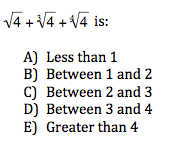
People who have never seen a GMAT question before almost stand a better chance on this question than those who have gone through all of the Manhattan GMAT books or through a Manhattan GMAT class or the resources of some other company. That is because people who have been indoctrinated in the Manhattan GMAT ways tend to try to approach this question in a very technical Mathematical sort of way when in fact a more logical approach is really called for. Anyone who has learned how to add and subtract exponents and roots will tend to view this as a question in which one can apply the algebraic technique typically called for in that case: factoring out.
However, taking a more logical and high-level approach to this question, we can see that the answers are given as ranges, not specific values. One must consider then, why would we try to factor out and solve a pretty nasty looking equation when the test-maker is not even giving us specific values as answers? Could it be that we are just meant to estimate here? Well if we start to head down that path we will see that we can very quickly make some positive progress. The first term (the square root of 4) is equal to 2, so we already know that the answer is C, D, or E. Now all we have to do is estimate what the second and third term equal. Well the cubed root of 4 is the number that when cubed equals 4. This is not going to be an integer, but if we try to estimate here we are going to find that the number has to be between 1 and 2. 1 cubed is 1 and 2 cubed is 8 so the number that when cubed equals 4 must be between 1 and 2. At this point the answer must be D or E. Well the same logic that applied to the cubed root of 4 would apply to the 4th root of 4. 1 to the 4th power is only 1, so the 4th root of 4 must be bigger than 1 and so the answer must be E.
Mathematically all that you really need in order to answer this question is a basic understanding of what the cubed root and 4th root of a number means. An overly technical approach on this question (like factoring out) is both unnecessary and likely to lead down a path that will NOT get you to the right answer. What is really needed is a very logical, clever, and intuitive approach and the same can be said of most GMAT questions!
So as you work through questions try to gauge whether you are approaching Quant questions as though they are testing your pure Math ability and Verbal questions as though they are measuring your pure Verbal ability. If you are, you are on the wrong track! Again, foundational knowledge is important, but it is not sufficient. The GMAT really aims to measure your Quantitative and Verbal reasoning ability (with a stress on the word “reasoning”) so you would do well to try to align yourself with what the test is really about. Try to think of the questions more as brain teasers than as “Math” questions or “Verbal” questions of the sort that you encountered in school. And most of all try to be creative and clever in the way that you solve problems, particularly the quantitative ones, since the GMAT, at its heart, is designed to reward creative problem solving and strong logical reasoning ability.
How to Improve your GMAT Verbal Score: The Secret Weapon
My title may be a little inflated but what I would like to cover in this post is what I believe to be the single most important strategy point for Verbal questions and one that cuts across all three Verbal questions types. It is what I call “The Principle of No Ambiguity.”
Most people understand that Quant questions are completely unambiguous: there is only one right answer and all of the other answers are necessarily wrong. Math is obviously very black and white in that way; if the answer is 4, the answer cannot also be 5 or 7. That’s just the way Math is. Most people, however, fail to realize that Verbal questions are the same way, at least as far as standardized tests are concerned: they are completely unambiguous. It would not be fair if there were two theoretically correct answers on a GMAT question. And barring a really bad, poorly written question (which I would argue appears around 1 out of every 500 questions or so) it just won’t happen on the GMAT.
What most test takers do on GMAT Verbal questions is pick the answer that they think is “best.” This, however, is not the right way to think about Verbal questions. “Best” implies that there are other answers that would be acceptable and that the correct answer might just be a little bit better than one of the other answers. Again, this cannot happen on the GMAT since it would lead to different answers being correct based on different people’s subjective assessment of what is “better.” The truth is that on all Verbal questions there will be 1 objectively right answer and 4 demonstrably wrong answers. And when I use the word demonstrably here, I mean it literally – one could demonstrate why each wrong answer is wrong.
Let me explain some of the ways in which this understanding can really affect ones Verbal performance (I would argue that it is the single most important strategy point to be aware of). As I have explained in other posts, hard questions are hard because most people get them wrong. So how do the writers of the test ensure that most people will get certain Verbal questions wrong? Well, they make sure that the correct answer doesn’t sound that good – they won’t make it wrong, of course, but it will be “acceptable” and will probably not sound like what most people would think the right answer should sound like. Further, they will make the wrong answers, or at least one of them, sound very, very good. That is why just picking the “best” answer or the “better” answer will often lead you astray on hard questions. The wrong answer probably will sound better than the right answer, but there will be something about it that just makes it actually wrong. The right answer might just be the answer that is simply “not wrong.”
Another important point here is how understanding this “Principle of No Ambiguity” can actually help you to get more answers correct. And this doesn’t even have to do with knowing more of the content – it is simply something that can push you to a deeper level of analysis and allow you to arrive at an answer with certainty rather than make what would amount to a guess (when you are choosing an answer that you think is “better” that is exactly what you are doing).
Essentially, when you are answering a question and find yourself in a position of ambiguity (i.e., you believe that 2 of the answers you are looking at could both be correct) you need to push yourself one step further to try to eliminate that ambiguity and understand why one of those answers must be right and the other one wrong (or, perhaps, why they are both wrong).
This principle is applicable to all 3 Verbal question types that appear on the GMAT, but it is perhaps most pertinent and useful on Sentence Correction questions. A great example of this is the following (very long) question from the Official Guide for Verbal Review:

Most people that I do this question with get it down to A and E (although some don’t even end up picking either of those). At that point, most people basically just guess and pick the one that “sounds better,” thinking that this is just the way it is on Sentence Correction questions (most people think choice A sounds better and pick that answer choice). But such thinking is a misunderstanding of the question type and of all Verbal question types on the GMAT. It would be completely unfair if choices A and E were both acceptable answer choices and if it were left to test takers to choose the one that they, in their subjective opinion, thought was better. There must be one and only one correct answer and the other answers must be demonstrably wrong.
So on the above question if you got it down to choices A and E and then got stuck there (or even if you thought that other answers could be correct as well), it means that you are missing something and that you need to dig deeper both logically and analytically. You either need to look more closely at the answer choices to try to spot differences or you need to consider the non-underlined part of the sentence. But there MUST be something that would make one answer correct and the other incorrect – again it is black and white!
In the above case, most people never glance back at the non-underlined part of the sentence, but in order to confidently answer this particular question correctly you MUST look there because it is there that the clue resides that would allow you to eliminate the wrong answers. Specifically, the “and which” that appears about midway through the sentence makes no logical sense unless there is a which that precedes it. It is really a parallel structure question, but most people never spot the clue that would allow them to see that. The correct answer is E: “….the federal government, which offered x…and which supported y…”
One could argue that this is an example of a straight up grammar issue and that a person who gets this wrong just doesn’t know their parallel structure rules. That is perhaps partly true, but I have found that the bigger problem is that most people just think that GMAT Sentence Correction is, by nature, an ambiguous exercise and that guessing is just part of the rules of the game. Of course one does sometimes need to guess, but if you realize that on every question there is only one acceptable answer and that the other answers are unacceptable for at least one reason (usually more), that alone may push you to be more analytical and more precise in the way that you approach Sentence Correction and indeed all of the Verbal question types.
I am not arguing that content (such as grammar knowledge) does not play apart – it does. And I am also not saying that just reading this post will help all of your Verbal troubles melt away. I tutor people for many, many hours and sometimes it takes a while and a lot of practice just to really accept and be able to apply this one concept. But I would argue that it is THE starting point for being good at Verbal questions because it moves you away from the idea that Verbal questions are ambiguous and that you will never be able to arrive at answers with a very high degree of certainty. Verbal questions are really just like Math questions and the sooner you realize that the sooner you will start to unlock one of the keys to success on the Verbal section.