
GMAT Critical Thinking
GMAT Myth or Fact?
You must get all, or at least most, of the early questions right in order to score well?
As you will see with most of the myths/facts in this series, there is some truth and some fiction in the statement above. So let’s start with what definitely is true…
Doing “well” early in the test does tend to lead to a better score. As a test taker, you are essentially trying to demonstrate that you are capable of answering hard or very hard questions correctly, and the sooner you get to those hard questions the better. Ideally you’ll have a strong start (prompting the test to give you harder questions), elevate to a level that is just at the edge of your abilities, and then hang on for dear life, getting some of the subsequent questions wrong but enough right to maintain that level for the rest of the test. If you do so poorly in the first 5 or 10 questions that the test starts pitching you easy questions, you can still right the ship, do well, and eventually start seeing harder questions. But if that shift doesn’t happen until midway through the test or later, the outcome will not be as good. Effectively, you’ll be punished for missing the easy and medium questions that you missed, and you’ll have less of an opportunity to show what you are capable on harder questions.
I have personally looked at many thousands of official GMAT Prep practice tests and nearly as many ESRs (Enhanced Score Reports) from official administrations of the GMAT to know that the above is true. But if you are interested in a more scientific study of the above phenomenon, there is a great post on GMAT Club that looks at different scenarios on the official practice tests and demonstrates convincingly the importance of the early questions.
All of that said, there are many sources of confusions related to the above that lead to misinformation and myths about the importance of the early questions. So let’s discuss these…
First, it is NOT necessary to get all or even most of the first 5 or 10 questions right to get a top score. All other things being equal, doing well at the beginning is more important than doing well at the end. So, it DOES make sense to frontload your time a little and spend a bit more time on the early questions, even at the expense of having a bit less time towards the end of the section. But one can still get a top score without getting all or even nearly all of the early questions right. The level of difficulty of the questions is a factor here: if 3 of the first 4 or 5 questions are 750 to 800 level questions, you may not get them right no matter how much time you spend on them. Unless you are aiming for a perfect score, that is no big deal anyway.
And even if you did get them right, well guess what? Now you will continue to see mostly very hard questions and unless you think you can hang in there and continue to mostly get those questions right, you are likely to falter and drop down into an easier bracket anyway, effectively nullifying the hard work you did to try to prove that you are at an 800 level. What’s worse is that if you spent an undue amount of time on those early, impossible questions, you might then not have sufficient time to deal with easier questions that come later in the test, ones that you definitely could have gotten right if you’d had the time. And if that happens, you’ll end up with a score that is lower than what your real ability would indicate.
Another slight point of confusion for people that leads to misinformation and misunderstanding is the idea that it’s the first 10 questions specifically that matter most. It’s as if the questions matter tremendously right up to question 10 and then it just drops off completely after that. I have an entire blog post devoted to this confusion, but there is nothing magical about the first 10 questions. I mean, why not the first 9 or first 11? A better way to think about it as that if the early questions matter slightly more, that emphasis declines gradually as you move away from question number 1. And by the time you are at question 6 or 7 or 8 or so, it probably doesn’t make sense to prioritize the early questions anymore. Crucially, if you HAVE spent more time on those early questions, then by the time you get to 7 or 8 or 9 you probably need to shift gears and speed up to make up for the extra time you spent the earlier questions. If you continue at the slightly slower pace that you started at, you’ll end up way behind and won’t be able to catch up.
Really the main danger with not having a nuanced understanding of the importance of the early questions and in believing that one needs to get all or virtually all of them right is that it often leads people to foolishly spend WAY too much time on questions that they are unlikely to get right. I have seen this over and over again with students I have tutored. Usually I catch the mistake in the practice tests and disavow students of their misunderstanding so that it doesn’t happen on the actual GMAT. But I have had students fail to heed my advice and just get killed on the exam when they spent 6 or 7 minutes on one of the first few questions because they just felt like they MUST get it right and then basically realized it was all over before the test had really begun because they were so far behind they couldn’t possibly catch up.
So yes, the early questions do have a SLIGHTLY increased importance and IF you see a question early on that you think you can get right, then it makes sense to frontload your time on the section and spend A LITTLE more time to ensure you get it right. But you cannot afford to throw excessive amounts of time at questions that you are likely to get wrong just because you think that you “have to” get the question right. Such thinking is incorrect and will cause you to end up with a score that is far below what you are truly capable of achieving.
Data Sufficiency Strategy: A Crucial Decision Point
In a previous post I discussed the tendency that people have to “go on a hunch” on Data Sufficiency questions. This is a big no-no because DS questions are designed to punish people for making unwarranted assumptions. Generally speaking it is best to try to prove what you think to be true on Data Sufficiency. Nevertheless, there are some cases in which it would not be wise to go that far, cases in which it might be better to make a good educated guess rather than spend a lot of time proving out your hunches.
The Problem That Most People Have: Not Pushing the Statements Far Enough
The problem that most people have on Data Sufficiency is that they don’t realize how far they need to go to prove the statements to be sufficient or not sufficient. Test takers are often satisfied with thinking that a statement is sufficient or not sufficient even though they are not really that sure. But as I often tell the people that I tutor, when you are 80% sure on Data Sufficiency that really means that you have about a 50% chance of getting the question right. That is because the statements are designed to appear one way when in fact they are the opposite (i.e, they appear to be sufficient when in fact they are not). So generally speaking you should push the statements further until you reach near 100% certainty on your judgment (see my post about “going on a hunch” for more about how to “prove” the statements are what you think they are).
The Crucial Decision Point
Yet there are cases in which it might be better to not spend the time to reach that higher level of certainty. Essentially there are 2 factors that you need to consider when you are evaluating a statement and deciding how far to go. You need to weigh your level of certainty against the amount of time that it would take to reach a higher level of certainty. For example, if you are close to 100% certain that a statement is sufficient and if it would take another 2 minutes to prove that it is sufficient, it would probably be best to take the educated guess that you have and not spend the extra 2 minutes. If, on the other hand, you are 75% sure and it would only take an additional 30 seconds to be more certain, that is an easy decision: spend the extra 30 seconds.
An Example
Let me give some examples of both sides of that decision process. I am going to use a question that I used before in another post because it so perfectly illustrates how this decision making process should unfold. Consider the first example:

In the above question, the statements don’t appear to be sufficient individually at first glance. Statement 2 definitely cannot be sufficient because without knowing what k is there would be no way to know what the remainder is since essentially we would be free to add whatever we want to 3^22 and could therefore change the remainder. Therefore we can say with certainty that statement 2 cannot be sufficient. Most people look at statement 1 and think the same thing: if we don’t know anything about n, we cannot answer the question. There are 2 things, however, that should give you pause. First, n is related to the exponent and is not just a number that we are adding on to the 3^(4n+2) so it could be that there is some pattern in what results when you take 3 to different exponents. The other thing is that if you conclude that statement 1 is also not sufficient, you would end up at answer choice C, which seems suspiciously obvious in this case. Of course if we know the value of n and k we will be able to answer the question. That is almost certainly too straightforward for a Data Sufficiency question.
So at this point you would find yourself at an important decision point, one that presents itself on many DS questions. The answer could possibly be C, though that is unlikely. The only plausible alternative, given that we know that statement 2 is definitely not sufficient, is that the answer could be A. Now, here is where you need to think about the amount of time it would take to prove that statement 1 is sufficient or not and weigh that against how certain you are about what the answer is on this question. If you were really unsure and if you thought you could work out very quickly whether there is a pattern with statement 1 such that it would be sufficient, then it might be worth doing that. However, if you feel really confident that the answer cannot be C and that choice A is the only plausible alternative and if you further realize that it will take you a very long time to prove that statement 1 is sufficient, it would probably be better to just guess A and move on. The answer in the end is A.
Another Example
Lets take a look at another example, one that will illustrate the other way that this decision process can unfold. Again this is a question I have used in other posts:
Tom, Jane, and Sue each purchased a new house. The average (arithmetic mean) price of the three houses was $120,000. What was the median price of the three houses?
(1) The price of Tom’s house was $110,000
(2) The price of Jane’s house was $120,000
On this question most people blow through statements 1 and 2, believing them each to be not sufficient and then come to choice C. But again, just like the last question, choice C seems deceptively easy. Of course knowing 2 of the home prices and the average would be enough to calculate the third and therefore the median. Again we face this all important decision point. How certain are we and how long would it take to achieve a higher level of certainty? Well in this case it really doesn’t take too long to test out numbers and see if we can indeed get more than 1 median. On statement 1 we can, and so most people then assume that statement 2 is also not sufficient since it seems to provide the exact same type of evidence as statement 1.
But again, how certain are we and how long would it take to become more certain? Most people are pretty sure in this case that statement 2 is not sufficient, but again it would not take very long to test numbers to see if we can get 2 different medians. If it takes an extra 30 to 45 seconds to be completely certain, that is probably worth it. Consider that if you don’t spend that extra 30-45 seconds and get the question wrong then you have wasted much more than 30-45 seconds. So again, if you are not close to 100% certain and if it wouldn’t take that long to be more certain, it is worth spending the time. In this case you would be rewarded for pushing statement 2 because it actually is sufficient, much to most people’s surprise.
Conclusions
To summarize, it is important on the one hand to push the statements and try to arrive at an answer with a very high degree of certainty. “Thinking” that a statement is sufficient or not sufficient is just not enough on Data Sufficiency since things so often turn out to be contrary to expectation. That said, there is an important decision point that comes on every DS question when you must ask yourself, “how certain am I and how much time would it take to become significantly more certain?” If you are almost 100% certain and achieving a higher level of certainty would take a long time, it is probably best to go with your gut and move on. But if you are not nearly as certain and if it would not take that much time to achieve a higher level of certainty then you should probably spend the time to really prove what you think to be true.
Why Isn’t My GMAT Score Increasing? Reason 2
In a previous post I discussed one of the main reasons that a person’s GMAT score can appear not to increase. In this post I will posit what I believe to be the second most common cause: a complete misunderstanding of the test and what it takes to do well on it!
Many prospective GMATers’ introduction to the test is through a major test prep company like Manhattan GMAT or Kaplan. This is not necessarily a bad thing, but often the result is a misunderstanding of the test. The GMAT is a reasoning test, not a test of content knowledge, yet that message is usually not made clear by the major GMAT prep companies. In particular I find that people who go through Manhattan GMAT, whether in a formal class setting or even just self-study using their books, often walk away with the impression that the GMAT measures one’s content knowledge. They go through all of the Math books and try to memorize all of the foundational knowledge that is presented and they often do the same with the Verbal books, particularly the Sentence Correction one, which covers every single grammar concept that you could see on the test. Often people go through the classes or the books without ever using the Official Guide or maybe only using it very sparingly. So they have no idea how the concepts in the book will apply to real GMAT questions.
I am not saying that the foundational knowledge presented in those books is useless. It is helpful and in some cases absolutely necessary to know a lot of that stuff. If you don’t know your exponent rules or 30-60-90 ratio you are clearly at a disadvantage on the test. Indeed, I will often have my students work through selected parts of the Manhattan GMAT books or sometimes those of some other company (depending on the situation and what the student needs). But, it is important to understand that the GMAT is a reasoning test, not a test of content knowledge. Real GMAT questions get much more at your conceptual understanding of things and the questions really reward creative problem solving and logical reasoning more than they reward content knowledge.
This understanding is often not apparent to people who are preparing for the test, especially those who start off with one of the major test prep companies. So if you are struggling to increase your score, you may want to take a look at how you are treating the questions. Are you just trying apply rules and technical methods that you learned in a test prep guide or class? Are you treating the Quant section as a test of your Math knowledge or pure Math ability and treating Sentence Correction questions as a measure of your grammar knowledge? If so, you are approaching the GMAT in the wrong way because although the content knowledge is important as a foundation it is only a foundation. Jumping off from that foundation, the GMAT seeks to assess your logical reasoning and critical thinking ability so it is best to try to approach the questions with that understanding in mind.
Obviously this post is not going to magically transform your ability to approach GMAT questions in unbelievably effective ways, but my hope is that at the very least it will help some people better align themselves with what the GMAT is really all about and in so doing potentially nudge them out of the pattern that is keeping them from improving their score. I have tutored many hundreds of people and the large majority of them come to me needing this refocus – they are not approaching the test in the right way and when I reframe it for them and help them understand how to better understand the test they start to improve.
Again, it would be impossible for me to do that for readers through a blog post, but I will give one example just to show how people tend to misunderstand the test. Consider the following question from the GMATPrep tests (for those who can’t make out the numbers, the question is asking you to add the square root of four, the cubed root of four, and the fourth root of four):
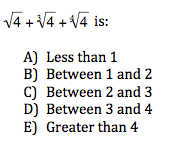
People who have never seen a GMAT question before almost stand a better chance on this question than those who have gone through all of the Manhattan GMAT books or through a Manhattan GMAT class or the resources of some other company. That is because people who have been indoctrinated in the Manhattan GMAT ways tend to try to approach this question in a very technical Mathematical sort of way when in fact a more logical approach is really called for. Anyone who has learned how to add and subtract exponents and roots will tend to view this as a question in which one can apply the algebraic technique typically called for in that case: factoring out.
However, taking a more logical and high-level approach to this question, we can see that the answers are given as ranges, not specific values. One must consider then, why would we try to factor out and solve a pretty nasty looking equation when the test-maker is not even giving us specific values as answers? Could it be that we are just meant to estimate here? Well if we start to head down that path we will see that we can very quickly make some positive progress. The first term (the square root of 4) is equal to 2, so we already know that the answer is C, D, or E. Now all we have to do is estimate what the second and third term equal. Well the cubed root of 4 is the number that when cubed equals 4. This is not going to be an integer, but if we try to estimate here we are going to find that the number has to be between 1 and 2. 1 cubed is 1 and 2 cubed is 8 so the number that when cubed equals 4 must be between 1 and 2. At this point the answer must be D or E. Well the same logic that applied to the cubed root of 4 would apply to the 4th root of 4. 1 to the 4th power is only 1, so the 4th root of 4 must be bigger than 1 and so the answer must be E.
Mathematically all that you really need in order to answer this question is a basic understanding of what the cubed root and 4th root of a number means. An overly technical approach on this question (like factoring out) is both unnecessary and likely to lead down a path that will NOT get you to the right answer. What is really needed is a very logical, clever, and intuitive approach and the same can be said of most GMAT questions!
So as you work through questions try to gauge whether you are approaching Quant questions as though they are testing your pure Math ability and Verbal questions as though they are measuring your pure Verbal ability. If you are, you are on the wrong track! Again, foundational knowledge is important, but it is not sufficient. The GMAT really aims to measure your Quantitative and Verbal reasoning ability (with a stress on the word “reasoning”) so you would do well to try to align yourself with what the test is really about. Try to think of the questions more as brain teasers than as “Math” questions or “Verbal” questions of the sort that you encountered in school. And most of all try to be creative and clever in the way that you solve problems, particularly the quantitative ones, since the GMAT, at its heart, is designed to reward creative problem solving and strong logical reasoning ability.
Practicing Strategic Guessing on GMAT Questions
Knowing how to guess well on GMAT Quant questions is a tremendously important factor on the test. Most people just don’t do it – they guess of course, but not well! But even if it is something that you are not doing it is a skill that can be acquired and practiced and this post will describe some of the ways to cultivate the ability to guess well on GMAT Quant questions.
First, let me describe the importance of strategic guessing. The GMAT algorithm obviously cannot differentiate between someone who really knows how to solve a problem and someone who is able to guess correctly. If on 10 700-level questions you were able to guess correctly on half, the algorithm would assume that 700 level questions are right at the limit of your ability even if you are actually only able to reliably answer 650 level questions and below. On my very first GMAT I was expecting a Quant score of about 46 but ended up with a score of 49 and I am certain that a big part of the reason I was able to score so high (at a time when I didn’t know that much about the test and how to answer many of the questions) is that I am very, very good at strategic guessing and I remember making some really good educated guesses on the test.
To detail all the ways in which you can make good educated guesses on GMAT Quant questions would require a lot of space so I will save that for some future posts (stay tuned), but I will give an example here just to show how effective it can be and then will spend the rest of the time discussing how one can practice strategic guessing, since it’s my opinion that most people never try to actively practice the technique (to their own detriment).
To begin with, it helps to understand that guessing on questions is obviously not about getting lucky. GMAT questions are designed so that strategic guessing is often made more possible – often several of the answers wouldn’t make logical sense so that one can often eliminate answers and make really good guesses. Why would the test maker allow for that? Because the GMAT is not a Math test; it’s a reasoning test and by allowing test takers to get the right answer using clever reasoning instead of complicated Math the test writers reward people for the kind of reasoning that the test seeks to measure. And it almost seems as though the harder the question, the more there was an effort put in by the GMAT writers to allow for strategic guessing. Take the below official GMAT question for example:
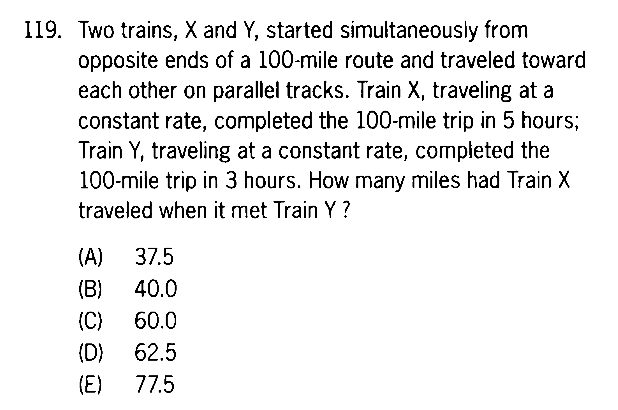
This is a pretty hard question, especially if you don’t know how to do it. But you can get the answer with some good old-fashioned reasoning and it might even be faster that way anyway. Just doing some quick calculating, train X is traveling 20mph and train Y is traveling 33 1/3 miles per hour. Therefore, the trains will meet closer to the side that train X is leaving from. Since the distance is 100 miles, train X will travel less than 50 miles and train Y will travel more than 50 miles by the time they meet. That already eliminates choices C, D, and E. Why would the GMAT writers allow for such an easy elimination? Well the fact that they put three answers that are all greater than 50 is deliberate – they are facilitating logical guessing, even encouraging it!
We can even go one step further. Given their different speeds, in 2 hours train Y will go 66 2/3 miles and train X will go 40 miles. So that means that by the time train X travels 40 miles, the trains will already have crossed. Therefore train X will travel less than 40 miles when they meet and the answer must be A. Again the insertion of 40 as an answer is deliberate to allow for the above kind of reasoning. And this question is but one example among many that demonstrate how strategic guessing is made more possible by the GMAT writers themselves.
So, how does one practice strategic guessing? Well the fact is that most people don’t even know that logical guessing is an important tool on the GMAT and even when they find that out (as my students obviously do) they don’t practice it. The first step is to realize that guessing is just a fact of the GMAT. Unless you are scoring 50 or 51 Quant, you are going to have to guess. So the question is, will you waste time on questions that you will likely be unable to answer and then make flustered panicked guesses or will you realize on some questions that it is not worth your while to solve the question and then proceed directly to logical, strategic guessing? Often you will find that when you choose to make a smart, educated guess you end up not guessing at all because guessing turns into eliminating all but one answer!
Once you accept that you will have to guess you can set about practicing the skill. Again it is beyond the scope of this post to discuss all the ways in which you can guess strategically (I will expand upon that in later posts), but you need to actually structure it into your studying. Most people, when they practice GMAT questions, say for example in the Official Guide, just try to answer every question without thinking about guessing. Of course trying to solve all of the questions is a good idea, but to mimic the test day experience, it is better to consider on every single question you do whether you could answer the question correctly and in a reasonable amount of time. This is part of the decision process that should happen on every question you see. If you have a high level of confidence and think that the question won’t take that long, you obviously go ahead and solve it. But if your confidence is not high and/or you think that it may take a very long time, then it would be foolish to dive in and try (at least on test day). Now when you are doing practice questions on your own, you’ll ultimately want to solve it, but why not first practice guessing on the questions that you think you might not be able to answer. After you guess you can try to solve the problem and then see if your guess was correct, but since letting go of questions and taking the time to make smart, educated guesses is part of the skill set that you need on the GMAT you might as well practice it as you prepare for the test. And frankly, you are not just practicing the art of guessing, you are forcing yourself to really think about the question and what to do with it before jumping in, an ability that is absolutely crucial to success on the GMAT.
What you will likely find, especially if you learn how to guess effectively and how to identify questions that are “low-percentage” questions for you, is that strategic guessing is often more likely to lead you to the right answer than sweating through a really hard problem and then making a flustered guess after you’ve realized that you wasted too much time. So as you work through the Official Guide or other official GMAT questions, take the time to assess whether, if you were to see that particular question on the GMAT, it would be wise to really attempt to answer the question or whether it would be better to make an educated guess and move on. Becoming a better and more strategic guesser is an often overlooked but critically important factor in achieving GMAT greatness so it makes sense to practice and cultivate that skill!
How to Deal with Hard Quant Questions on the GMAT: Creatively!!!
The scoring algorithm on the GMAT is such that in order to achieve a high score on the test you have to be getting hard questions right. As most people understand, the number of questions that you get right is not the major factor…your score is based on the level of difficulty of the questions that you are able to answer correctly. But how do you answer hard GMAT questions correctly?
First of all, it is helpful to consider what makes a hard question “hard.” I often like to ask my tutorees this question and I usually get answers like “the Math is very difficult” or “the wording of the question is tricky.” These can certainly be aspects of hard questions but at their core what makes hard questions hard is that most people get them wrong. Obviously the GMAT writers have a very good sense for whether a question will be easy or hard when they are writing it, but the real test comes when the question is introduced as an experimental question. If most people get the question right, it is an easy question and if most people get it wrong it is a hard question. It’s as simple as that.
This raises an interesting dilemma. If the way to get a high score on the GMAT is to answer hard questions correctly and if a hard question is one that, by definition, most people get wrong, how can you answer questions correctly that most people get wrong? Well, if we are talking about Quant questions you really have 2 choices. Either be better at Math than almost everyone who takes the test or find ways to approach the questions that deviate from what most people would do. Think of it this way: if on a particular question you do what everyone else is doing you will be just as likely as they are to get the question wrong, unless you are better than them at the very same approach. And if the question is very hard then you need to be better than maybe 80 or 90 percent of test takers (many of whom are very, very good at Math).
If, however, you take a more creative approach and differentiate yourself not by your pure Math ability but by being a more creative problem solver, you put yourself in a position to get hard questions right that most people will get wrong (including people who may be better than you at Math). You can essentially sidestep what makes the question so difficult for most people in the first place by approaching it in a novel and unconventional way.
Since rewarding good quantitative reasoning and creative problem solving is at the heart of what the GMAT does, there are many, many official GMAT questions that would illustrate this point – so many that I don’t even know where to start! One example that I often like to use with students is the below question:

The above question can be approached in a number of ways. The most obvious method and the method that most people choose is to use algebra. But the algebra is pretty difficult on this question. Well, it’s not that difficult if you spot how to do it, but most people really don’t know how to do it and so they go round and round with algebra until it is clear that they are not going to get to the answer in a reasonable amount of time. That is why this question would be considered difficult – most people don’t know how to approach it so most people get it wrong.
But there is another way. You could just pick numbers. If you’ve had some practice picking numbers on other questions, this becomes a layup of a question when approached in this way. As long as we satisfy the first 2 equations we can pick whatever values we want and then just answer the question (numerically, not in terms of a and b). So if we make x=3 and y=2, then a=5 and b=1. Now we just answer the question – what does 2xy equal? Well, 2(3)(2)=12. Now we just need to find which answer equals 12 when we plug our values of a and b (5 and 1) into the answer choices. Choice A equals 12 and none of the other answers do, so the answer is A.
That could almost be done in one’s head without writing anything down – I am not suggesting you do that, but the question becomes so easy and so straightforward that it clearly ceases to be a hard question. So why is it considered a hard question? Because almost nobody would approach the question in that way and when approached algebraically the question is significantly more difficult. I must admit that the fact that most people would us algebra here still surprises me a little bit because to me it is pretty intuitive to pick numbers on a question like this (but of the hundreds of people I have done this question with, very few of them have picked numbers). And I am not saying that there is anything wrong with doing the algebra. I would be comfortable doing the algebra on this question as well and if it is perfectly clear to you how to solve it algebraically then that is certainly an acceptable approach too. But personally I would CHOOSE to pick numbers because it would be clear to me how easy the question would become if I took that approach.
To be clear, it should be understood that the test itself is designed to reward creative problem solving and good, clever quantitative reasoning, not the ability to regurgitate Math formulas and reflexively apply methods in an automatic way. So by taking a more creative, strategic approach to the questions you are actually aligning yourself with what the test largely seeks to measure. I have found over the years that convincing people of this fact is one of the necessary steps in getting people to become better GMAT problem solvers. Too many people see the test as a measure of their pure Math ability and therefore misunderstand the true nature of the test.
So, as you elevate your GMAT game and start to encounter those harder Quant questions just remember that what makes those questions hard is that most people get them wrong. And the reason that most people get them wrong is not a lack of Math ability but an inability to approach the problems in creative and effective ways. As you practice try to cultivate an ability to think outside the box and flex your problem solving and reasoning muscles more than your pure Math muscles.
Data Sufficiency and the “Spectrum of Sufficiency”
Understanding the “Spectrum of Sufficiency” is a key advanced strategy on Data Sufficiency questions and yet very few people seem to be aware of the technique. Nevertheless, understanding the concept and how to apply it can really help you answer some of the most difficult DS questions correctly and can also help prevent you from falling into traps.
First, before explaining the concept, let’s begin by discussing an underlying assumption upon which this strategy is based: one of the key features of Data Sufficiency questions is that they are meant to trick test takers and therefore obvious answers on DS questions are almost always wrong (this is true even for most easy and medium level DS questions). Now, it is not always easy to tell what an “obvious” answer is on DS, but as you get more accustomed to DS questions you will start to get a sense for what is just too straightforward and obvious. Furthermore, if you are scoring pretty high on Quant, chances are that the questions you are seeing will be quite difficult, so in that case especially obvious answers will tend to be sucker answers that you don’t want to pick.
Now, enter the “Spectrum of Sufficiency.” Basically, the answer choices on DS questions can be arranged from left to right on a scale of “how much information is needed to answer the question.” In other words, choice D indicates that each statement alone was sufficient, so you really didn’t need that much information to achieve sufficiency. Next to that would be choices A and B, which indicate that one of the statements was sufficient but the other not. Next would be choice C, which of course indicates that you needed yet more information to arrive at sufficiency: both statements were needed together. Finally, you have choice E, which indicates that no matter what you did (using the statements both alone and combined) there was not enough information to answer the question. I personally arrange the answer choices in this order from left to right:

The key here is that if you arrive at what appears to be a somewhat obvious answer, not only can you infer that it is probably wrong, but you can also get some sense for what a probable answer would be based on the “Spectrum.” In other words, if you are considering choice C, but feel like it is a bit too obvious, the right answer is probably just to the right or just to the left of choice C, since its unlikely that you are going to jump completely to the other end of the spectrum (though that definitely does happen in some cases). In fact, I find that people often think that there is not enough information to answer the question when sometimes there is, so with my students I often find myself advising them to “stay to the left.” In other words, when they think the answer is E, it is actually C. Or when they think it is A or B, it is usually D.
Let me give an example to illustrate how powerful this can be. Consider the following question (from the GMATPrep exams):
This is a very difficult question, but if you are skilled at the art of Data Sufficiency then there is a good chance that you can get it right even if you can’t properly “solve” it. What do you think the obvious (read sucker) answer is on this question? The sucker answer is C, because obviously if you have the values of n and k, you can answer the question since then you would know exactly what number is being divided by 10 (some DS neophytes miss even that because they think that they would actually need to solve for the remainder and think that it would be impossible to do that with such a large number, when of course it doesn’t matter what that remainder actually is so long as we know that we would be able to solve for a specific remainder).
Now, if C is not the correct answer (which at this point we can’t say with 100% certainty it is not), what are the next most likely answers. Well, if we look to the right on the Spectrum of Sufficiency, that would put as at choice E, but that is impossible because for sure if we have the values of n and k we could answer the question. So E is out. Looking to the left, we have A or B. It is unlikely that the answer would be D at this point since both statements appear at first to be insufficient (so for them to both all of a sudden become sufficient is unlikely). Therefore, it would be best to consider choices A and B and ask yourself which of the two statements is more likely to be sufficient (given that we know that E is out and that C is possible but extremely unlikely). Well, if you look at the statements, statement 2 really cannot be sufficient because even if we know that it is 3^22 + k, without knowing the value of k we could never know the remainder. Just think about it: 3^22 is some number, but we could add 1 or 2 or 3 or whatever on to that and that will change what the remainder will be when divided by 10 (or any number really).
At this point, you have to look at statement 1 and consider that it is very likely sufficient given that E, B, and D are out (remember that D is out because statement 2 is not sufficient so that eliminates both B and D) and that choice C is just a little too easy and straightforward (it would be too straightforward even if this were an easy DS question, which it is not). So now you can look at choice A not blindly trying to surmise if it is sufficient or not, but with the foreknowledge that it probably IS sufficient – you just need to figure out how. Here is the thing: even if you don’t have the time or the wherewithal to figure it out, I would just guess A and move on. In other words, you could basically guess correctly on this question (and it is a very difficult one at that) without even really knowing how to solve it. That is pretty powerful stuff and it demonstrates how strategy and technique on Data Sufficiency itself are as important or more important than the content that underlies the questions themselves.
I won’t go into a full explanation here of why statement A is sufficient, but just briefly, since n must be a positive integer and since n is multiplied by four, this ensures that the powers will increase by increments of 4 (you could see this by plugging in integer values of n). And there is a pattern in the units digit of powers of 3 such that the units digit is always the same as you advance by jumps of 4 (from, say, 3^6 to 3^10 to 3^14). If you knew exactly how to solve this, that is obviously great, but the truth is that you can answer this question without knowing how to solve it and without even spending the time that it would take to solve it, just by understanding the Spectrum of Sufficiency and the way it relates to the trickery of the question type.
So when you are solving Data Sufficiency questions, be very wary of “obvious” answers and consider the alternatives by using the Spectrum of Sufficiency. Often you will find, as in the above case, that the some of the alternatives can be completely ruled out and this will often put you in a position between two answers: the more straightforward, obvious one and an answer that sits immediately to the left or right on the Spectrum. At that point, go back and consider that that other answer might very well be correct or if you need to guess, avoid the obvious choice and select the most reasonable alternative. Again, based on my experience people much more often think that they don’t have enough information when in fact they actually do, so if you are really stuck and not sure which way to go, take this advice: Stay to the Left!
What Do the GMAT and GRE Really Test?
Virtually everyone who begins studying for the GMAT and GRE (and even many people who are months into the process) tend to misunderstand what the tests are really about. The GMAT and GRE are not typical tests for which you just memorize a body of content knowledge and then demonstrate that you can regurgitate that knowledge on the test. The GMAT and GRE are tests of quantitative and verbal reasoning (with stress on the word reasoning).
Trying to think of it from the perspective of the test writers, if one is trying to measure someone’s reasoning or critical thinking ability one needs to format the questions in a certain language (and I don’t mean English here). One could do it using pictures, puzzles, etc. The writers of the GMAT and GRE have chosen to test this more general logical reasoning in the language of Math and Verbal “content,” for lack of a better word. That is in part because being adept in the language of Math and Verbal “content” is obviously essential to success in graduate school.
So within the Quantitative and Verbal sections of the GMAT and GRE, being familiar with the language of the Math and Verbal “content” is clearly helpful in doing well on the tests. Both tests have a “content foundation” that serves as the basis for the questions that appear: Math concepts and formulas, common vocabulary words (in the case of the GRE), and key grammar concepts (in the case of the GMAT). Becoming more proficient in the language of that “foundational content” IS an important part of GMAT and GRE preparation.
But my 2 decades of experience teaching, tutoring, and taking the tests have taught me that by far the most important factor leading to success is the reasoning and critical thinking ability that a test taker applies on the GMAT and GRE. That should make sense if we accept that this is what the test is designed to measure in the first place. Now again, it’s not puzzle-reasoning or picture-reasoning, it’s Quantitative and Verbal reasoning, so familiarity with the content, the language, is an important factor. But that will only get you so far…it will allow you to speak the language of the test, but not necessarily answer the questions correctly. Ultimately the content just serves as a jumping off point to access the reasoning and problem solving skills that the questions are really designed to test.
This truth has been borne out with the many hundreds of students that I have taught and tutored over the years and it serves as the guiding principle for what we do here at Reason Test Prep. Anecdotally, it is also the primary reason that I was able to do so well on the GMAT and GRE the first time I took them. At this point I know the tests so well, including the underlying content, that its not that hard for me to get almost every question right. But when I first took the tests, there was an embarrassingly large body of content that I didn’t know, especially with respect to math rules, grammar, and vocabulary, and yet my scores from my first try on the GMAT and GRE are pretty close to where I stand now (my first GMAT was a 760 and my most recent one was a 790, for example). So all of that extra knowledge that I now have about the tests and especially the content that is at the foundation of them really only translates into a very small score difference. When I look back on that 760 on my first GMAT, its very clear to me that the main reason I was able to score so high is that I am very good at reasoning and problem solving. I was aware of this when I took the test and I understood even then that this is what the GMAT is all about, so I applied it very consciously to great effect.
So when we at Reason Test Prep prepare students for the GMAT and GRE, we make sure that they understand and align themselves with the true nature of the tests. Over the years, I’ve unfortunately had a few students who didn’t want to see the tests that way and who insisted in trying to conquer the GMAT or GRE by sort of memorizing all of the different question types and the methods for solving them – needless to say the results were not good. On the flip side I have had many more students who didn’t initially understand the nature of the tests but who quickly saw that reasoning and critical thinking trump all else and in many of these cases the students never really achieved the complete mastery of the content that they probably should have achieved. Yet in most of these cases the students ended up doing really well on the GMAT or GRE, often far better than would have been predicted by their pure math or pure verbal ability.
So as you prepare for the GMAT or GRE and work through individual questions, don’t let a focus on the underlying content trump the larger reasoning and problem solving aspects to the questions, since reasoning and critical thinking skills ARE at the heart of what the GMAT and GRE attempt to measure.