
GMAT Quant Section Timing
Data Sufficiency as the Key to a High Quant Score
Back in the old days the GMATPrep tests did not break down your performance by question type on the Quant and Verbal sections. Nor was there an Enhanced Score Report that did so on the actual GMAT. Now, with the existence of practice tests that indicate your performance on each individual question type and the Enhanced Score Report that does the same for the actual test, it is possible to understand how your overall score is arrived at and what your score is for each specific question type.
With that, I have noticed a trend with my students that I could not have known in the past and that probably has relevance for many GMATers out there: they tend to score higher on Data Sufficiency than on Problem Solving. Now, I don’t mean to imply that everyone scores higher on DS than PS – people who don’t really understand Data Sufficiency tend to underperform there – predictably. But what I would say and what I will explain below is this: for people who are not naturally great at Math, there is an opportunity to really excel at Data Sufficiency and have that score pull up the entire Quantitative score.
First, let me explain a little bit about the scoring. When people take practice tests on the official software or when the look at their Enhanced Score Report (ESR), what they tend to look at are the percentiles. This is especially true on the ESR since the percentiles are what appear on the center of the page, but if you look at the bottom of each page in the “Summary” section you will see hidden down there a breakdown of what your score was for each question type, and this information is what is most telling. Your overall score tends to be roughly the average of your scores for each question type. So if you scored 40 on Problem Solving and 48 on Data Sufficiency, your Quant score will probably be 44.
What I started to notice a while back in reviewing practice tests and ESRs with my students is that they usually do better on DS, sometimes overwhelmingly so. Now, they don’t necessarily come to me in that state – often it is the opposite on the early practice tests that they take and DS is much worse. But as we start to approach their test date and they are ramping up and taking a lot of practice tests, most of my students just score higher on DS. A very common scenario for me is to see something like 49DS/42PS for a Quant score of 45 or 46. And at the end of the day they may end up at 49DS/45PS for a 47 Quant.
Here is what is significant about that. Many of these students are not great at Math and are probably not capable of getting really hard Problem Solving questions right on a consistent basis. But the beauty of Data Sufficiency is that it is much more about logic and reasoning than it is about Math. So if you really understand the question type well you can dominate on DS without really being master of the Math that underlies the questions. And what I have found with my students is that it is much easier to get them to a place where they are killing it on DS than on PS, in part because PS questions, especially at the higher levels, really do require a little bit more Math know-how or even innate Math ability.
It is outside the scope of this post to really get into the specifics of how to dominate on Data Sufficiency (though many of my other posts expound upon some of those strategies). And obviously if you are aiming for a 49 Quant, you need to be equally dominant on PS questions. That said, I would argue that if you are not naturally good at Math, Data Sufficiency really presents an opportunity to far outperform your natural Math ability and end up with a score that puts you above those who are innately better at Math!
I tutor plenty of people who routinely get scores of around 40 on PS and in my opinion are unlikely to ever be hitting scores like 44 and above (they are just not that great at Math and have come a VERY long way to even get to a 40 on PS). Yet they will routinely get scores of 47 to 49 on DS. So they come away with scores of 44 or 45 on Quant. Again, for someone aiming for a 49 or 50 Quant, that might not seem that impressive, but for people starting at 30 Quant who are not very good at Math, a 44 or 45 Quant is pretty damn impressive! And for the people I tutor who are able to get to 44 or 45 or 46 on PS (again often people who are not great at Math), they will often end up with a 47 or even 48 Quant, in part because of the higher DS score.
So if you feel like you are the type of person who is just innately not that good at Math, consider that, in Data Sufficiency, you have an opportunity to really dial into the logic of the question type (along with its common structures, traps, etc.) in a way that would allow you to far exceed what you might expect from your pure Math ability.
GMAT Scoring Algorithm: The First Ten Questions
It is a pretty well-accepted fact that on the GMAT the early questions are slightly more important than the late ones, especially on the Quantitative section (everything I have seen in all my years as a GMAT tutor has confirmed this and there have been some good experiments done by others on the GMATPrep tests that seem to confirm the theory pretty conclusively…feel free to follow the link to read those articles). In this post I hope to help clear up some of the often misunderstood implications of this idea and help you understand how to manage your time given the slightly disproportionate importance of the early questions.
The first thing to clear up is that there is nothing particularly special about the number 10 that makes it the clear demarcation point. Whenever I think about this concept it makes me think of a conversation I had with my wife about getting pregnant. She was nearing 35 and remarked that she needed to get pregnant before she turned 35 (she was 33 or 34 at the time) because she read that you have a greater risk of having a baby with birth defects when you are over 35. But like the first 10 question concept on the GMAT, it is best to think of it on a spectrum. It’s not like you are not at risk when you are 34 and then all of a sudden you are at a huge risk when you are 35. You are at a slightly greater risk at 35 than at 34 but at 34 you are at a greater risk than at 33 and so on. Why do experts use the number 35 then? The same reason that people say the first 10 questions on the GMAT – it’s a nice round number. So again, the best way to think about it is as a spectrum. The first question is probably a little more important than the second one and the second a little more important than the third and so on. Once you get to AROUND question 10 it probably ceases to be as important, but it is a spectrum – I would be a little more willing to go for it on question 7 than on question 9 and perhaps a little more willing on question 9 than question 11. But at around the question 10 mark it probably ceases to be important.
The second thing to clear up is that this is all a question of degree…again it is a spectrum and is not black and white. It is NOT true that you have to get the first 10 questions right to get a really high score (in fact most people who get really high scores do not get the first 10 right). And no single question really matters that much – not even question 1. I actually just tutored someone last week who got question 1 wrong and then got the next 12 or so right and then proceeded to get a lot more wrong throughout the rest of the test (probably about 13 wrong total) and got a 49. And I have tutored many, many people who have gotten 3 or 4 wrong in the first 10 and gotten 48 or 49. The early questions do seem to matter more and certainly if you dominate on the first 10 or 15 questions you are extremely likely to have a very high score, but again it is a matter of degree – those questions matter a little more and doing well on them will help, but it is not necessary to absolutely dominate on the early questions to get a high score.
Again the way I like to think of it is as a spectrum where the questions go from slightly greater importance to slightly less importance as you move from question 1 forward. People tend to overcompensate and spend WAY too much time on the early questions and then find themselves completely out of time later on the test and are then forced to guess on 10 or more questions. That generally will not lead to a high score. So what should you do? Well it depends a little on the level that you are at…
If you are not at a very high level on Quant then spending loads of extra time on the early questions is particularly ineffective. Here’s why: Assuming that you do get some of those really early questions right (like maybe 1 through 3 or 1 through 4) you are then going to be seeing very hard questions. If you are really not capable of answering those questions correctly then spending extra time on them is a foolish waste of time. There is no sense in getting yourself in front of 800 level questions and spending a lot of time on those questions if you are really at a 600 level. Even if you get some of those questions right you will probably be way behind on time and then you will eventually find yourself getting 600 level questions wrong later on in the test. At that point not only will you not get the equivalent of 800 on Quant but you probably won’t even get 600 Quant because the algorithm knows that even if you were able to get some 800 level questions right, anyone who is really at an 800 level would also get nearly all 600 level questions right.
If on the other hand you are at a pretty high level on Quant (let’s say you are scoring 40 or higher on Quant) then it probably does make sense to spend some extra time on those early questions. But only to a point!!! First of all, if the question is one that you just don’t think you can answer in a reasonable amount of time then it just isn’t worth it – guess and move on. Spending 5 minutes and then getting a question wrong is just about the worst thing you can possibly do on the GMAT. What I recommend is being A LITTLE more willing to spend time on those early questions and that extra willingness should progressively diminish as you approach the 10 question mark.
So for example, let’s say question 3 looks really hard but you think that you can probably answer it in 3 or 4 minutes. On question 3 I would probably go for it. If that same question appeared at question 23 and if I was already 5 minutes behind I would probably choose to guess and move on. That is how the particular placement of a question on the test may affect whether you try to answer it – at question 3 maybe you would go for it and at question 23 maybe you would not.
To take another example, however, if I was at question 7 and was thrown a really difficult question that I wasn’t sure I could answer I might choose to just guess and move on. It would depend on how likely I thought I was to get the question right, how long I thought it would take, and how far ahead or behind I was at that point. If I was 50/50 and thought it was going to take 4 minutes I probably wouldn’t do it (at question 7). If that same calculus presented itself on question 1, however, I might go for it. I might even go for it at question 7 if by some chance I was ahead a little on time, but if I was already behind I probably wouldn’t go for it.
So what we are talking about here is a SLIGHT willingness to spend more time on the early questions. You should NOT feel as though you need to get those first 10 right – that probably won’t happen anyway and trying to make it happen is likely to screw up the entire section. And again this strategy of spending a little more time on the early questions makes more sense for someone who is at a higher level. In either case remember that it never makes sense to spend a lot of time on questions that you are unlikely to get right. Instead find a way to guess cleverly – even if it is question 1.
One more thing I would like to add to round out this discussion. The strategy of spending a little extra time on the early questions depends on counterbalancing that by spending less time on the questions that follow. In my opinion you should probably not spend more than about 5 extra minutes on those first 10 questions. So if you should be at the 55 minute mark by the end of question 10, I would not want to be any further than the 50 minute mark at that point. It’s not that hard to make back those 5 minutes across the course of the rest of the section, but again you have to be aware of the need to do so and plan accordingly. If you “strategically dump” a few questions scattered through the rest of the section (say, for example, questions 13, 17, 25, and 31 just for argument sake) you should be totally fine. And if you were able to do it on what you knew to be very hard questions, questions that you would have been unlikely to get right anyway, all the better!
All of this takes some practice. Some people are able to perfect it pretty easily. Others need to take 4 or 5 practice tests before they understand how to strike the right balance. So be patient and give yourself some time to implement it properly. The key is to be aware that it is a balancing act and that you can’t go too far in spending extra time on those early questions!
GMAT Scoring Algorithm: Quant vs. Verbal
In this post I would like to expound upon a theory of mine that gets at the slight differences in the scoring algorithm on the Quant and Verbal sections of the GMAT. In a previous post I commented on the fact that although on the Quant section the number of questions you get right has very little to do with the score you receive, on the Verbal section the number of questions right matters much more. I don’t think there is any official explanation for this phenomenon, but I have long had a theory that I think makes pretty good logical sense. Understanding the nuances of the algorithm can help you learn what exactly you need to do to achieve a high score on each section.
Quantitative questions, by nature, are completely unambiguous. If x equals 10, then x can’t also equal 15 (well ok it can in a quadratic equation and in some other special situations, but you get the point). Verbal questions, on the other hand, are by nature a little less black and white than Math questions. Of course GMAC writes questions that are technically unambiguous, but the problem is that it is tough to make a Verbal question really, really hard without crossing the line a little into ambiguity, so there tends to be a limit to how hard a Verbal question can realistically get. That problem does not exist on Quant. There is almost no limit to how hard the test writers can make a Math question and it will still be completely unambiguous, completely black and white.
This helps explain the differences in the algorithm on each section. On Quant, the questions can pretty much just keep getting harder and harder until nearly everyone would get the questions wrong. Really only at the very top reaches of the Quant section (say scores of 49-51) will people get less than 10 questions wrong. So for most people the differentiating factor in scores on the Quant section is just the level of difficulty of the questions that test takers are able to get right consistently. If your breaking point is 650, your score is 650 (or whatever that would correspond to on the 6-51 scale that the section is scored on). If your breaking point is 720, then your score is 720. The number of questions that you get wrong is not really a factor except, perhaps, in differentiating between people who get a 49 and 50 and 51.
But since there is more of a limit to how hard a Verbal question can get (again before it starts to drift over the line into “ambiguous/unfair question territory”), the number of questions right and wrong starts to become more of a differentiating factor. That’s because many test takers get up into the very hardest Verbal questions so at that point the main way for the algorithm to differentiate between a 38 Verbal and 40 Verbal or 42 Verbal and 45 Verbal is just by number of questions wrong. This is a bit of an oversimplification since the level of difficulty of the questions may vary a little so that would still be a factor in the score, but at the higher reaches of the Verbal scoring spectrum the score really becomes much more about number of questions wrong. And to be at a really high Verbal score (like 40+) you really can’t have many questions wrong. For a 40 you might have 8 or 10 wrong, but for a 44 or 45 you are probably talking about 5 or 6 wrong or even less and then for 47 Verbal or 49 Verbal you are looking at 1 or 2 wrong total!
There are a few implications to be drawn from this. First of all, since you are likely to get a lot of questions wrong on the Quant section, it really does not make sense to spend undue time on questions that you are likely to get wrong anyway. Furthermore, running out of time at the end of the Quant section is not that big a deal (assuming that you actually select answers to all of the questions to not incur the unanswered questions penalty). Again, you are going to get a lot of questions wrong anyway so coming to question 34 with 2 minutes left and having to make some educated guesses on the last 3 or 4 questions will not impact your score that significantly.
On the Verbal section, on the other hand, you need to be much more careful about time management and not put yourself in a position of having to guess on the last 3 or 4 questions. That will impact your score more detrimentally, especially if you were tracking toward a really high score. If you had only 5 questions wrong up until question 35 and then had to guess on 36 through 41 and got 5 of those last 6 wrong for a total of 10 wrong on the Verbal section, that would be a big deal and would lower your score significantly.
Another upshot is that you need to be a little more certain of your answers on Verbal questions than on Quant questions. Most people probably feel like the opposite is what often happens since the nature of Verbal questions is that they feel ambiguous, but of course they are not and you need to be that much more rigorous in the way you choose your answers to ensure that you limit the educated guessing to a bare minimum. You just can’t afford to get Verbal questions wrong with the same frequency that you can Quant questions. What that means, practically speaking, is that you can’t run out of time on the Verbal section and that you need to choose answers because you KNOW they are right, not because you THINK they are right. That is obviously easier said then done, but see my post on The Principle of No Ambiguity for some more insight on that idea.
Knowledge is power and on the GMAT having a better understanding of the scoring algorithm is the kind of knowledge that helps lead to a better score. In a future post I am going to come back to the issue of pacing strategies on the Quant section so stay tuned!
GMAT Time Management: The 2 Kinds of Strategic Guessing
There are 2 different kinds of guessing that test takers should apply on the Quant section of the GMAT – both of them are crucial to success on the GMAT. But in my years of tutoring, I have found that most people just aren’t aware of how different guessing techniques apply on the test…and as a result their scores suffer.
Unstrategic Guessing
When most test takers say they are “guessing” on the GMAT, what they really mean is that they are giving up after spending a couple of minutes on the question and then just selecting an answer. And although everyone will find themselves in that situation on the GMAT at one point or another, that kind of unstrategic guessing is to be avoided. The problem is that you end up spending a lot of time with nothing to show for it. Spending 2 or 3 minutes on a question and then having to make a completely blind guess is a killer and yet people fall into the trap of doing that all the time on the GMAT. You shouldn’t be committing to spending 2+ minutes on a question unless you believe you have a very good chance of answering it correctly or at least narrowing down the answers to make a good strategic guess.
The Different Types of Guessing Explained
Really there are 2 types of strategic guessing that you should try to apply, especially with regard to Problem Solving questions (I will explain more about Data Sufficiency below). The first is when you read a question, realize that you don’t really know how to attack it, and give up and guess immediately. The guess itself might not seem strategic, but the decision to immediately let go of the question and guess is! The other situation is when you think you have some chance of making headway on the question and are willing to spend a minute or 2 in order to make a better educated guess or, if you are lucky, discover the path to the answer. Both of these kinds of guesses have a place on the GMAT, especially from a time management perspective, so let me explain when they each cab be useful.
Guessing to Gain Back Time
There will almost certainly be questions on your GMAT (perhaps many) that are clearly too hard and that you probably shouldn’t even attempt to solve. This is a difficult pill for many people to swallow but it is just a fact of the test. Many test takers foolishly waste time trying to solve every question. But they would be better off spending a little extra time on questions that they probably can answer and quickly dumping questions that they cannot. Many people spend 1.5 or 2 minutes minimum on every question so they never give themselves a chance to gain back time for the questions that they spend 3+ minutes on. But, if when a question comes on the screen you can quickly identify it as a low percentage question and if it seems like spending some time on it is not even likely to yield an educated guess, then you should immediately dump the question and move on.
Yes, you will probably get the question wrong, but that is the great thing about the quant section of the GMAT: you can get a lot of questions wrong and still have a great score. Why waste time on something that you will likely get wrong anyway? If you can spend 20-30 seconds and then dump a question, and if you can do that on 3 or 4 or 5 question on the test, you can gain back 5 or 6 or 7 minutes that you can then apply to other questions (ones that you can answer but that require more than 2 minutes).
An example of the above is a hard combinations/permutations question. These questions are usually very difficult and they also don’t lend themselves to strategic guessing. Plus, they are easily identifiable. Most people see those questions and say, “oh shit!” Yet most people still attempt to solve them even when it is pretty clear that they are in over their head. Do yourself a favor: if you recognize that the question is one that you don’t really know how to solve and if you don’t think that playing with it is likely to lead to an answer or to a very good educated guess, just guess and move on!
Guessing to Not Lose Time
This probably sounds the same as the type of guessing that was just described, but it is actually a little different. Whereas the above guessing is aimed at gaining back time, the other kind of guessing is not going to gain you back time, but it will prevent you from falling further behind on the test – sort of like damage control. Now, I am not talking about spending 2 minutes, realizing that you are not going anywhere, and then making a fairly random guess. In tutoring I have seen that many GMATers have a very good internal clock set at 2 minutes – basically what they do is “go for it” on every question and then at around 2 minutes if an answer isn’t in sight they just give up and guess (usually unstrategically). Again, that is not a very good way to succeed on the test.
If when you first look at the question you are not sure if you can solve it but if you see that you might be able to eliminate some answers and make a pretty good educated guess, then it would probably be worth spending a little time on it in order to make that guess. This takes some time, however, and that is why this guessing method is a little different from the previous one. In this case you will need to think through the question some, you may need to play with the answer choices a little, do a few calculations, etc. That will probably cost you close to 2 minutes. But if that allows you to come up with a pretty good educated guess then it is probably worth that time.
An example of this type of scenario would be a geometry question. Some geometry questions are very hard, but because figures are always drawn to scale unless otherwise noted on Problem Solving questions (not the case on Data Sufficiency), one can often make an educated guess just by looking at the figure, using some logic, and glancing at the answers to see what is reasonable. So in that kind of case it might be worth spending 1.5 or 2 minutes on the question to see if you can make some headway or make a good educated guess.
Data Sufficiency
Data Sufficiency is a little different, in my opinion, when it comes to guessing. If you understand Data Sufficiency well it is usually possible to make a pretty good educated guess on almost every question. Therefore, I would almost never do a 30 second dump on a DS question. I might not spend 2 minutes because in some cases it would be clear that the question is really hard and/or really time consuming, so I might be looking to move on and not waste a lot of time on the question, but I would not just make a blind guess in order to move on. I would just try to quickly eliminate what is obviously wrong and then make an educated guess based on the 2 or 3 possibilities that seem most likely after a quick assessment. In the end that may take only 1 minute or maybe a little bit more, so DS often presents itself as an opportunity to make back a little time if you are falling behind. And if you are really “Data Sufficiency savvy” and especially if you avoid the sucker answer, you have a very good chance of getting the question right anyway.
Conclusions
The key in all of this really is to assess your chances on any particular question (and I mean really assess and think about how you would solve it or whether you think you even can) before diving in and spending time on it. In my years of tutoring I have found that very few people really do this. They usually just “go for it” on every single question and then dump the question, making a pretty unstrategic guess, after about 2 minutes.
This is a recipe for failure, especially for people who tend to work slowly or who just can’t seem to get to right answers in about 2 minutes (and there are many, many people who fall in that category). The way the scoring algorithm works, you are likely to get about half of the Quant questions wrong anyway, so it really pays to take some time up front to consider what your best option is: should you go straight for it or perhaps completely dump the question and gain 1.5 minutes back, or maybe spend a little bit of time working with the question so that when you do guess you have a better than 20% chance of picking the right answer. Applying this overall strategy will put you in the driver’s seat and prevent you from feeling like you are constantly behind, frantically rushing, and never having enough time to really think clearly in a way that allows you to effectively answer the questions that you know you can answer.
Why Isn’t My GMAT Score Increasing? Reason 3
In a couple of previous posts I discussed some of the main reasons that people don’t see much of a score increase when preparing for the GMAT. In this post I will turn to yet another common cause of artificially low GMAT scores: poor time management!
Over the years I have tutored a number of students whose lower than desired GMAT scores have been almost entirely the result of poor time management. One girl in particular stands out. She came to me with a 560 score on the official test, but after I had my first session with her it was clear to me that she should be in the 700 range. Unfortunately she had no idea how to properly manage her time on the test, particularly on the Quant section, and the result was a score that was really well below her potential. I tutored her for about 6 weeks focusing almost entirely on time management and she managed to score a 710, which is probably the score she should have had in the first place had she known how to manage her time better!
First of all, one must have an understanding of how the scoring algorithm works on the GMAT. The exact algorithm is unknown and is undoubtedly far more complicated than I will be able to convey in this post, but there are some generalizations that can be made and an understanding of these general principals will go a long way toward achieving a better score.
Most people understand that the number of questions right is not the main determinant of a person’s score. Actually, at the higher levels of the Verbal section the number of questions right definitely does matter, so you need to be careful on Verbal not to put yourself too far behind because a string of wrong answers at the end of the test will definitely lower your score, especially if you were doing really well and tracking towards a very high score. But on Quant, most people get around half of the questions wrong and even people who score at the top end of the scale still get between 1/3 and ½ of the questions wrong. It is the level of difficulty of the questions that you are able to answer consistently right that really determines your score.
It is important to understand and really accept this fact – people whose score is artificially low because of poor time management often do not fully appreciate this fact and it is often the principal reason that their scores suffer. You can’t think of the GMAT the way you think about most tests (where, in order to score well, you need to get almost every question right). Because the questions will just keep getting harder and harder, it is a simple fact that at a certain point the questions will be too hard for most test takers and at that point it becomes foolish to waste time on questions that you are likely to get wrong anyway. This fact about the GMAT is one of the things that makes the GMAT so great, in my opinion. Just think of it – you know you are going to get about half of the questions wrong anyway, so it takes a lot of the pressure off on a questions-by-question basis. In my opinion this is much better than a test in which you need to get almost every single question right in order to do well (the GRE is actually an example of this and that is one reason that for some people the GMAT is a better test than the GRE).
Even if you believe that you are capable of answering all or most of the questions correctly, you need to be able to do it in a reasonable amount of time. If you can’t and if you try anyway, one of two things will probably happen (both bad): One is that you will spend a ton of time on the question and obviously if you do that too many times you will run out of time before you get to the end of the test. The other is that you will spend 2 minutes on the question, realize that you can’t answer it in a reasonable amount of time, and then make a guess, having now wasted 2 minutes. One of these scenarios is what plays out for most people who have time management issues.
The first step in correcting this is realizing that you will likely get ½ the questions wrong no matter what you do. So it doesn’t make sense to “go for it” on every question, especially if it’s a question that you recognize is hard and/or will take a long time to solve. My next post will cover strategic guessing and the different ways you can guess, both to save time and maximize your score, so stay tuned for that. A second consideration that will help is to realize that 2 minutes per question is just an average (75 minutes divided by 37 questions), but that does not mean that you should aim to spend 2 minutes on EVERY question. I wrote another post about this titled “The Myth of 2 Minutes Per Question” so I don’t want to rehash all that I wrote there, but basically it is fine to spend 3 or 4 minutes on some questions (if you are reasonably confident that you can get them right in that amount of time). If you couple that with some strategic “let-gos” (questions that you quickly dump once you realize that they are really hard or time consuming), you get a much better result than spending 2 minutes on every question since you can spend 3 or 4 minutes on some questions, thereby allowing you to get those right and much less than 2 minutes on other questions that you probably wouldn’t have had right even if you had spent 3 or 4 minutes!
One last thing I will mention and come back to in a later post: the early questions definitely matter a little bit more and warrant slightly greater attention. Again this topic deserves its own blog post, but it is a pretty accepted fact in the GMAT world that the first 5 or 10 questions on the test have a greater impact on your score (and all of my experience over the last 11 or 12 years tutoring people for the GMAT supports that). Now, some people go overboard with this and spend way too much time on the early questions and then completely run out of time way too early in the test. Basically what I advise my students is that you should be A LITTLE MORE WILLING to go for it on the early questions. So if you are close to an answer and you need an additional 30 seconds, I would take it. Or if it’s a question that you are not sure that you can answer but you think maybe you can or you anticipate that it will take a long time but that you can do it, then I would go for it if you are on question 2 or 3 or something like that. BUT, you should not feel like you have to get all of the early questions right – that is almost certainly not going to happen and aiming for that will almost certainly cause you to fall way, way behind. The other thing to throw in here is that the questions decrease in importance the further you move away from question 1, so you should be less and less willing to spend extra time as you move further into the test and by around question 10 it doesn’t really matter anymore.
Remember, time management is an issue for almost everyone who takes the test. I scored a 780 on the GMAT and even I have to push myself on both sections to make sure I finish on time. Even if you are slow in the way that you work, it just means that you need to learn how to be more selective in choosing which questions to really go for it on so that you have time to answer the ones that you really can answer. The flip side of that is that you obviously need to be willing to let go (quickly let go) of questions that are low percentage questions for you or that will clearly take a long time to answer. My next post will expand upon how exactly to judge when to skip a question and the different types of guessing that can be employed in order to save time and maximize your score. Stay tuned!
Practicing Strategic Guessing on GMAT Questions
Knowing how to guess well on GMAT Quant questions is a tremendously important factor on the test. Most people just don’t do it – they guess of course, but not well! But even if it is something that you are not doing it is a skill that can be acquired and practiced and this post will describe some of the ways to cultivate the ability to guess well on GMAT Quant questions.
First, let me describe the importance of strategic guessing. The GMAT algorithm obviously cannot differentiate between someone who really knows how to solve a problem and someone who is able to guess correctly. If on 10 700-level questions you were able to guess correctly on half, the algorithm would assume that 700 level questions are right at the limit of your ability even if you are actually only able to reliably answer 650 level questions and below. On my very first GMAT I was expecting a Quant score of about 46 but ended up with a score of 49 and I am certain that a big part of the reason I was able to score so high (at a time when I didn’t know that much about the test and how to answer many of the questions) is that I am very, very good at strategic guessing and I remember making some really good educated guesses on the test.
To detail all the ways in which you can make good educated guesses on GMAT Quant questions would require a lot of space so I will save that for some future posts (stay tuned), but I will give an example here just to show how effective it can be and then will spend the rest of the time discussing how one can practice strategic guessing, since it’s my opinion that most people never try to actively practice the technique (to their own detriment).
To begin with, it helps to understand that guessing on questions is obviously not about getting lucky. GMAT questions are designed so that strategic guessing is often made more possible – often several of the answers wouldn’t make logical sense so that one can often eliminate answers and make really good guesses. Why would the test maker allow for that? Because the GMAT is not a Math test; it’s a reasoning test and by allowing test takers to get the right answer using clever reasoning instead of complicated Math the test writers reward people for the kind of reasoning that the test seeks to measure. And it almost seems as though the harder the question, the more there was an effort put in by the GMAT writers to allow for strategic guessing. Take the below official GMAT question for example:
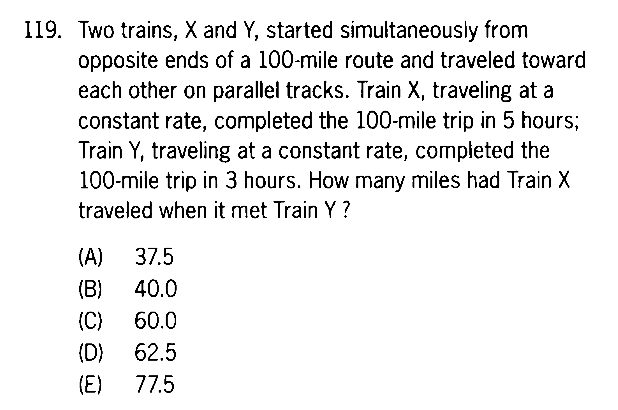
This is a pretty hard question, especially if you don’t know how to do it. But you can get the answer with some good old-fashioned reasoning and it might even be faster that way anyway. Just doing some quick calculating, train X is traveling 20mph and train Y is traveling 33 1/3 miles per hour. Therefore, the trains will meet closer to the side that train X is leaving from. Since the distance is 100 miles, train X will travel less than 50 miles and train Y will travel more than 50 miles by the time they meet. That already eliminates choices C, D, and E. Why would the GMAT writers allow for such an easy elimination? Well the fact that they put three answers that are all greater than 50 is deliberate – they are facilitating logical guessing, even encouraging it!
We can even go one step further. Given their different speeds, in 2 hours train Y will go 66 2/3 miles and train X will go 40 miles. So that means that by the time train X travels 40 miles, the trains will already have crossed. Therefore train X will travel less than 40 miles when they meet and the answer must be A. Again the insertion of 40 as an answer is deliberate to allow for the above kind of reasoning. And this question is but one example among many that demonstrate how strategic guessing is made more possible by the GMAT writers themselves.
So, how does one practice strategic guessing? Well the fact is that most people don’t even know that logical guessing is an important tool on the GMAT and even when they find that out (as my students obviously do) they don’t practice it. The first step is to realize that guessing is just a fact of the GMAT. Unless you are scoring 50 or 51 Quant, you are going to have to guess. So the question is, will you waste time on questions that you will likely be unable to answer and then make flustered panicked guesses or will you realize on some questions that it is not worth your while to solve the question and then proceed directly to logical, strategic guessing? Often you will find that when you choose to make a smart, educated guess you end up not guessing at all because guessing turns into eliminating all but one answer!
Once you accept that you will have to guess you can set about practicing the skill. Again it is beyond the scope of this post to discuss all the ways in which you can guess strategically (I will expand upon that in later posts), but you need to actually structure it into your studying. Most people, when they practice GMAT questions, say for example in the Official Guide, just try to answer every question without thinking about guessing. Of course trying to solve all of the questions is a good idea, but to mimic the test day experience, it is better to consider on every single question you do whether you could answer the question correctly and in a reasonable amount of time. This is part of the decision process that should happen on every question you see. If you have a high level of confidence and think that the question won’t take that long, you obviously go ahead and solve it. But if your confidence is not high and/or you think that it may take a very long time, then it would be foolish to dive in and try (at least on test day). Now when you are doing practice questions on your own, you’ll ultimately want to solve it, but why not first practice guessing on the questions that you think you might not be able to answer. After you guess you can try to solve the problem and then see if your guess was correct, but since letting go of questions and taking the time to make smart, educated guesses is part of the skill set that you need on the GMAT you might as well practice it as you prepare for the test. And frankly, you are not just practicing the art of guessing, you are forcing yourself to really think about the question and what to do with it before jumping in, an ability that is absolutely crucial to success on the GMAT.
What you will likely find, especially if you learn how to guess effectively and how to identify questions that are “low-percentage” questions for you, is that strategic guessing is often more likely to lead you to the right answer than sweating through a really hard problem and then making a flustered guess after you’ve realized that you wasted too much time. So as you work through the Official Guide or other official GMAT questions, take the time to assess whether, if you were to see that particular question on the GMAT, it would be wise to really attempt to answer the question or whether it would be better to make an educated guess and move on. Becoming a better and more strategic guesser is an often overlooked but critically important factor in achieving GMAT greatness so it makes sense to practice and cultivate that skill!
Information Overload on Data Sufficiency
There are many things that tend to give people trouble on Data Sufficiency, but one of the most common issues that people face is the problem of “information overload.” One of the skills that Data Sufficiency tests is a person’s ability to simultaneously juggle multiple pieces of information. If you forget that the question restricted you to positive integers you will probably get the question wrong. Lose sight of what your goal is as you are plugging in numbers and you will probably get the question wrong.
So how do you make sure that you take stock of all of the information without getting completely overloaded in the process? There are several strategies that can help you be more organized and focused on Data Sufficiency.
First of all, you must slow down and take your time with the question stem. Most Data Sufficiency neophytes blow through the question stem in their rush to get to the statements. Don’t be a Data Sufficiency neophyte!!! The question stem often provides crucial information, both in terms of restrictions imposed and facts that are pertinent to the question being asked. If you don’t take proper stock of this information you are heading into the statements with a severe handicap.
In terms of the restrictions it might be helpful to jot down them down on your notepad so that they are staring you in the face as you work on the problem. Something as simple as:
Restrictions:
X is a positive integer
Y < 0
And in terms of the other factual information provided in the question stem, you need to try to “digest” it so that you can more easily understand what it is saying. This is often the crucial step on many DS questions. So for example, consider the following question stem:
If x is greater than 0 and if 5x + 6 < 3x + 16, is x a multiple of 3?
In the above case, you MUST process the information given before turning to the statements. If you solve for x in the inequality, you get x < 5. This is a critical step because the question already limits you to values of x that are greater than 0, so essentially x must be between 0 and 5. The only multiple of 3 in that range is 3, so basically the question becomes, is x = 3? I wouldn’t say that you can ‘t answer this question correctly if you don’t take these initial steps, but you are certainly making your job much, much harder.
The other major strategy that I would argue is crucial to avoiding information overload, especially on questions that involve plugging in numbers (i.e., number property questions), is to be goal oriented when turning to the statements so that you have a good sense of what the point is of what you are about to do. That may sound obvious, but most people don’t do it. In fact, even when I am tutoring someone and explain this process and then give a student a question with which to practice the technique, they usually still don’t do it!!!
I could write a whole post or even several posts about just this technique, but for now let me try to keep it somewhat general and perhaps give one example to illustrate.
Before turning to the statements, you should have some idea of how you are going to deal with them and ready yourself accordingly. This would require you to glance at the statements to understand what type of information they provide (equations, facts in sentence format, etc.). This doesn’t mean that you should actually start working on the statements but you should get an idea of the type of information they provide so that you can know what your goal might be and how you are going to deal with the statements.
Again, this is probably most important on number property questions. Take the following question for example:
If m is an integer, is m odd?
(1) m/2 is not an even integer
(2) m – 3 is an even integer
There are multiple ways to approach this question, but especially with statement 1, picking numbers is a very good option. However, many people get spun around when dealing with statement 1, in part because they are not clear about what their goal is before turning to the statements. It’s important, first of all, to understand that the issue on all DS questions is that you are trying to determine if there is one answer or more than one answer to the question given. If there is one answer, the statement is sufficient; if there is more than one answer it is not sufficient.
So if you pick numbers that satisfy a particular statement, you are going to get an answer – that doesn’t really tell you anything since there is always at least one answer to every Data Sufficiency question. The real question is whether there is more than one answer possible to the question given.
So in the above problem, since the question is asking if m is odd, the goal is actually to see if m can be both odd and even (since m must be an integer, m must be either odd or even – it can’t be a non-integer). Again this may seem obvious to some, but so many people fail to fully appreciate that this is the goal on the above question. It bares repeating: The goal is to see if, given the statements, m can be both odd and even. This simple step allows one to stay focused on what the goal is when things start to get complicated at the statements – without it many people will suffer from information overload and get completely spun around, forgetting what the point of what they are doing actually is.
So again in the above example, when dealing with statement 1, the goal would be to satisfy the statement with both an odd and even value of m. If we plug in m=3 we would see that 3/2 is not an even integer so we satisfied the statement with an odd value of m. Now, if we plug in m=4 (in an effort to try an even value of m) we will see that it doesn’t work: 4/2 equals 2 so that is an even integer and that violates the statement. But that doesn’t mean that we should just stop there. We already got our odd value of m, but just because the first even value we tried didn’t work does not necessarily mean that no even value would work.
Here again is where having a goal in mind helps. I have seen countless people get spun around at this point and either start plugging in odd values, which is pointless since we already proved that m can be odd, or sort of flail about and not know what to do next. Our goal was to see if we could get both an odd and even value of m to work in the statements. We got our odd value so all we want to try at this point is even values. M=4 did not work, so we want to ask, “is there an even value for m that I can plug in that would make m/2 not an even integer?” Well 2 is an even integer and 2/2 equals 1 and that is not an even integer, so that satisfies statement 1. So m could also equal 2. That is our even integer. Statement 1 is therefore not sufficient since m could equal an odd or an even.
We can do a similar thing with statement 2. If we make m = 7, then 7-3 equals 4, which is even, so we succeeded in getting an odd value of m to satisfy the statement. Again people get confused here because the result of putting 7 in for m is even, but as long as we remember that our goal was to plug in an odd value for m and have it satisfy the statement, we shouldn’t get confused.
If we try to get an even value to work in statement 2, however, we will not be able to do it. If we try m = 8, 8 – 3 is odd so that violates the statement. If we try m = 10, we will get another odd result. We can keep trying but at a certain point it will become obvious that every even value that we try for m is going to yield an odd when we subtract 3. So we are only able to get an odd value of m to work in statement 2 and therefore statement 2 is sufficient. So the answer to the question is B.
Again there are other ways to deal with this question and for some people the process of picking numbers described above would be obvious and intuitive, but I have seen many, many people struggle with this question and ones like it. One of the keys to not getting lost in questions like these is to be goal oriented and to know what that goal is as you head into the statements. Without that focus many people get overwhelmed by the combination of info in the statements and question stem itself (on this question all of the mention of odd and even in both places often overwhelms and confuses people).
So on Data Sufficiency questions take your time with the question stem, process all of the information given to you, take stock of any restrictions that are imposed, and know explicitly what your goal is before turning to the statements!
GMAT Time Management: The Myth of 2 Minutes Per Question
When preparing for the GMAT you will often hear people say that you should spend 2 minutes per question on Quant questions, yet this advice is misleading and I have seen it hurt many test takers. Of course with 62 minutes and 31 questions you do have on average 2 minutes per question, but that does not mean that should aim to spend 2 minutes on each question.
This flaw is usually based on 2 misunderstandings, in my opinion.
First of all, people have a misunderstanding of how many questions they need to get right on the Quant section in order to have a high Quant score. Now, if you are aiming for a 50 or 51 then indeed you need to have almost every question right. But if you are aiming for a 47 or 48, then you can probably have close to half of the questions wrong, provided of course that you are seeing hard questions throughout the section and getting many of those questions right as well. So when they think that they need to get virtually every question right, people tend to want to distribute their time equally across all questions. Again, this strategy is based on the flawed assumption that you need to get almost every question right. Given that most test takers are likely to get about half of the Quant questions wrong, including people at the top of the Quant scale, it obviously doesn’t make sense to spend undue time on questions that you are likely to get wrong anyway. One of the worst things that can happen on the test is to spend 5 minutes on a question and then get it wrong!
This leads to the second realization, which is that not all questions require an equal amount of time. First of all, some questions will be relatively easy and can be done in a minute or less (this is even true for high scorers….in my own GMAT attempts, one thing that was obvious to me was that I was definitely seeing some Quant questions that were not that hard). But other questions genuinely require more than 2 minutes and if you have an internal 2 minute timer going on every question, like many test takers do, you are never going to be able to answer some of those harder questions. So some questions are worth spending 3 or 4 minutes on, provided that you think you have a very good chance of answering them correctly with the extra time.
Now, what do you do if you need 3 or 4 minutes on a lot of questions but don’t have that many questions that you can answer in 1 minute or less. Well then you need to guess on a certain number of questions and the goal is to try to figure out when you see a question whether it is one that you are likely to be able to answer correctly in a reasonable amount of time or not. Consider this thought experiment: What if you were capable of answer most hard questions correctly but you needed more like 3 minutes on each question? Well if you limit yourself to 2 minutes per question you are going to get most of those questions wrong. If, theoretically, you could throw away every 3rd question very quickly and just spend 3 minutes on each of the other questions, you would get 2/3 of the questions correct and you would finish on time. Of course it takes some time to decide whether a question is worth your while or not and you are not always going to get the questions right that you don’t throw away, but on the flip side you may be able to guess really well on the one’s that you do throw away and get some of those right as well!
The point is that guessing is a part of the GMAT and should be part of your strategy, especially on the Quant section. Anecdotally, the first time I took my GMAT I got a 760, but I knew that I had time management issues, so I went into the test expecting to guess on at least 3 or 4 questions (not because I couldn’t answer them, necessarily, but because I knew that they would take me a long time and that I needed to make up time somewhere). So when I started to fall behind on time, I would go into what I call “Shark Mode.” I would basically hunt for an opportunity to let go of a question and guess in the interest of gaining back some time. So I would be on the lookout for a really hard question that I also thought I could make a pretty good educated guess on in a very short amount of time. It was really a shift in attitude such that guessing was not an act of defeat but an act of self-preservation. And if you consider that most GMATer probably don’t do this, you very likely give yourself a big advantage over other test takers when you do!
So if time management is an issue for you, as it is for most test takers, remember that some questions genuinely do require more than 2 minutes per question and part of being successful on the GMAT is knowing how to decide whether a question is worth your time (even if takes 3 or 4 minutes to solve) or whether it would be better to quickly let go of the question and make a quick, educated guess.